Cristine Hall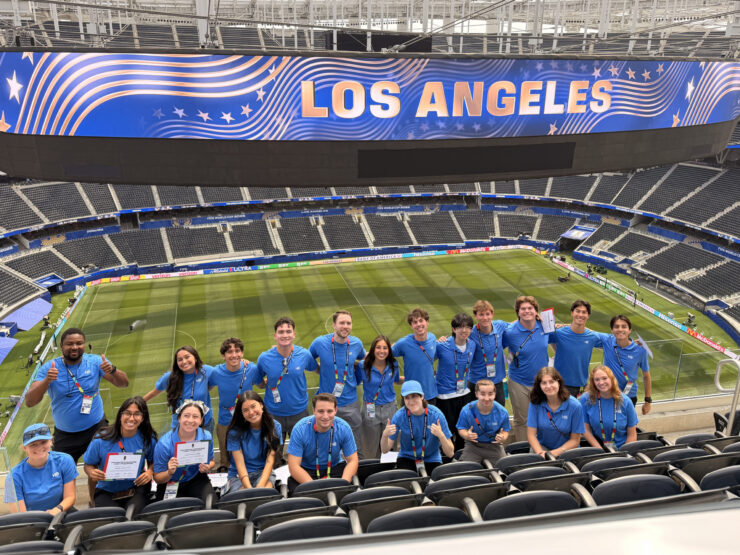
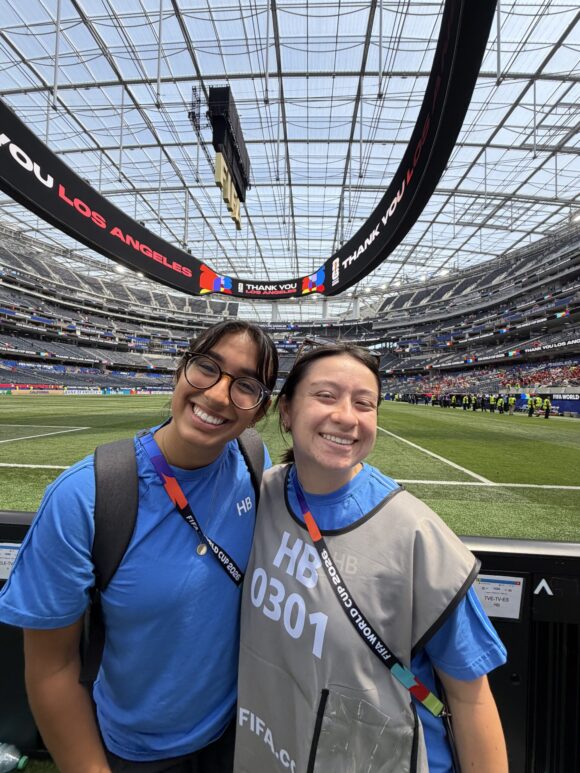
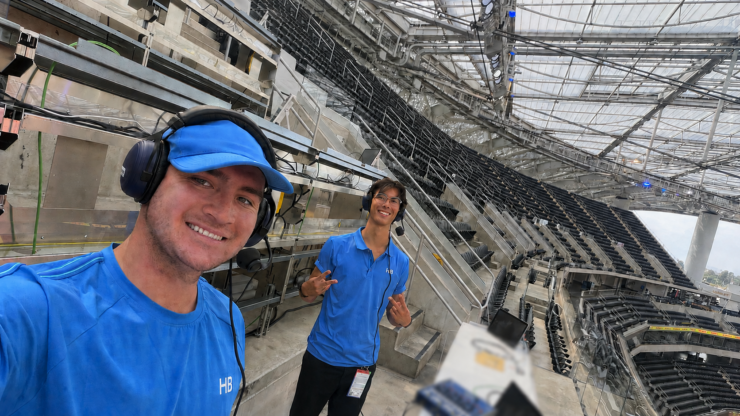
When 20 Chapman University students arrived at SoFi Stadium for the 2026 FIFA Host Broadcast (HB) Intern Programme, they stepped into the pace and pressure of a live World Cup production. Their assignments included supporting the Venue Production team with their daily tasks, preparing the commentary kits in the media tribune, and shooting, gathering, and delivering 360-degree footage to editors.
They drew experience gained through hands-on productions, fast-paced coursework, and close faculty guidance at Chapman. Here’s how Chapman got them ready:
Live broadcast experience begins early
Meet More of Chapman’s World Cup Interns
Interested in sports media?
Chapman students can take on meaningful production roles soon after arriving on campus. Nico Schwegler ’27 called his first game for the student-run Chapman Sports Broadcast Network (CSBN) within a week of starting college. A month later, he was a sideline reporter at Homecoming.
Those opportunities helped Schwegler develop the confidence he brought to support audio systems used by international announcers during the internship.
“The thing I want to do more than anything professionally is call a World Cup game,” said Schwegler, a broadcast journalism and documentary major. “This only reinforced my desire to do that one day.”
Coursework builds confidence for live production
Fast-paced coursework gives Chapman students practice meeting deadlines, shifting priorities, and working as a team. In Associate Professor Suzanne Lysak’s “Chapman News” course, students pitch, film, write, produce, and edit a live newscast each week.
That experience helped Caroline Chang ’26 adjust to the pace at SoFi Stadium, where she supported the venue production team.
“You don’t expect that at all, and then you’re there and think, ‘Wow, I feel like I’ve done this before,’” Chang said.
Faculty take a personal interest in students’ goals
Chapman faculty members help students build on early opportunities and consider where those experiences could lead. Lysak was the only faculty member from any university to contact Schwegler after his admission, he said, and she remains someone he turns to for career advice.
CSBN faculty adviser David Goedhart saw the internship as a chance for students to apply their experience on a much larger stage.
“This internship gave our students an incredible opportunity to work on a global stage and to be part of a production that reaches billions of people,” Goedhart said. “It’s also one of the hardest productions to do because you are dealing with so many different languages and logistical challenges.”
Sports broadcasting draws on talent across majors
Students from different academic backgrounds found roles that matched their skills. The group included majors in broadcast journalism, business administration, computer science, electrical and software engineering, English, film and television production, and strategic communication. Together, they contributed to broadcast operations, commentary support, and immersive video.
Bella Ortiz ’27, a strategic communication major with minors in visual journalism and public relations, helped deliver 360-degree footage to editors. Her coursework strengthened her visual storytelling and taught her to communicate clearly and accurately — skills she relied on as assignments and priorities changed.
Language and communication skills solve problems
Live broadcasting depends on communication and adaptability as much as technical knowledge. Lucas Patton ’28 brought another valuable skill: fluency in Spanish. When a Paraguayan television crew discovered it was missing a piece of equipment before a match, the broadcast operations intern spent nearly 30 minutes translating between the crew and his supervisors as they worked out a solution.
“I grew up glued to my TV screen watching the World Cup,” said Patton, a broadcast journalism and documentary major. “If you had told me two years ago when I arrived at Chapman, ‘You’re going to help produce World Cup coverage in two years,’ I would have laughed. But with Chapman, it was possible.”
The experience held a deeper meaning for Patton. His grandfather, who was from Spain, was a broadcast engineer in Chile.
“It was a very heartwarming, full-circle moment,” Patton said. “A generation and a half later, I was watching Spain play right in front of me.”