Robert Hitchcock
Artificial intelligence has entered Americans’ top 10 fears, with about half of adults afraid it could harm the political process or hurt the economy, according to the 12th annual Chapman University Survey of American Fears.
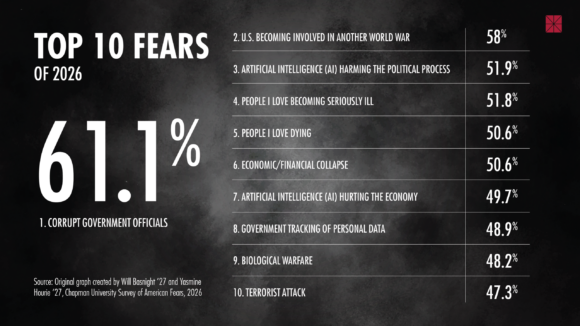
For the first time, researchers asked several questions examining fears about artificial intelligence. Fear of AI harming the political process ranked No. 3 (51.9%), while fear of AI hurting the economy ranked No. 7 (49.7%). Government corruption remained the nation’s leading fear (61.1%), followed by U.S. involvement in another world war (58%).
By tracking Americans’ fears over time, Chapman researchers examine how concerns change, which ones endure, and how fear shapes people’s lives. Undergraduates work with faculty to analyze the survey data and pursue research questions of their own, gaining experience that supports their goals for graduate study and careers.
“These findings make it clear that Americans are concerned not just about what AI might mean for their jobs, but about its potential impact on our political system and the economy,” said Christopher Bader, Ph.D., professor of sociology and founder of the survey. “As artificial intelligence becomes more integrated into everyday life, understanding these fears will be increasingly important. We expect concerns about AI to remain a significant part of the national conversation in the years ahead.”
What Changed, and What Endured
Fear of the United States becoming involved in another world war rose from No. 6 in 2025 to No. 2 this year. Bader said that higher ranking as well as biological warfare and terrorist attacks entering the top 10 could reflect concerns about the conflict with Iran.
But rankings alone can obscure changes in how many people report a particular fear, said Ashley Wendell Kranjac, Ph.D., associate professor of sociology and director of the Earl Babbie Research Center.
“I think it’s important to keep in mind that the top 10 doesn’t tell the full story, and even though a lot of fears went up this year, there are a lot of fears that are also actually lower,” said Kranjac, noting that fewer Americans reported fearing air pollution or a terrorist attack than last year.
Fears for loved ones remained prominent, even as new concerns emerged. About half of Americans reported being afraid or very afraid of someone they love becoming seriously ill (51.8%) or dying (50.6%).
“What I’m seeing more and more over time is that our fear about our loved ones is going to always be there, no matter what’s going on in the world,” Bader said.
Concern and Hope About AI
Americans’ views of emerging technologies varied depending on how they might be used. Respondents were more hopeful than fearful about abundant clean energy, life-extension medicine, and humans working with robots in manufacturing. Continuous employee monitoring, genetically engineering human babies, and AI romantic partners generated far more fear than hope.
Seth Benzell, Ph.D., assistant professor of business and economics, said people tend to respond more positively to technologies that expand what they can do.
“When you frame it as AI or robots that are going to allow you to build something that you weren’t able to do before … those get people a lot more excited,” Benzell said.
The survey also found that frequent AI users reported less fear of the technology. Among people who use AI at least weekly, 46% feared it could harm the political process, compared with 55% of those who never use it. The finding shows an association between AI use and lower fear, though it does not establish that using the tools makes people less afraid.
The survey is a project of Chapman’s Wilkinson College of Arts, Humanities, and Social Sciences. NORC at the University of Chicago, a nonpartisan research organization, surveyed 1,221 adults online from April 7 to April 21, 2026, using its probability-based AmeriSpeak panel. The margin of error is plus or minus 3.79 percentage points.