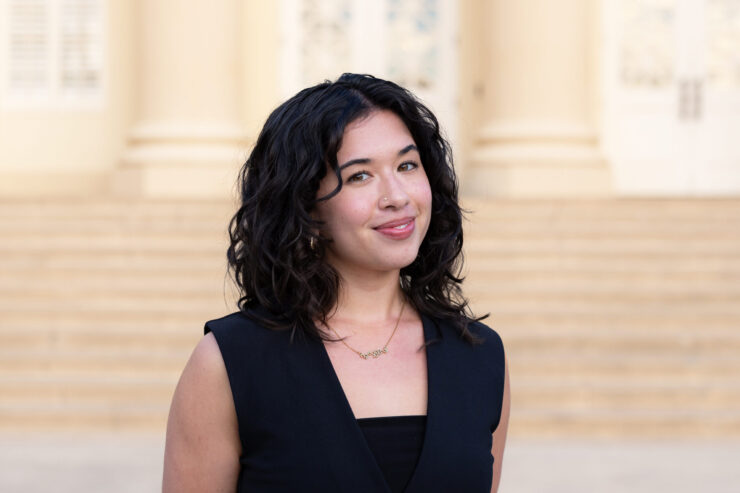
Ashley Agatep ’27 is still an undergraduate, but she has already tracked climate-related disasters from its Jet Propulsion Laboratory, studied tropical forests alongside NASA and MIT researchers in Costa Rica, and become the lead author of a study published in a Nature Portfolio journal.
Now, the Chapman senior is one of 32 Americans selected as Rhodes Scholars for 2027. At the University of Oxford, she plans to pursue two master’s degrees—first in environmental change and policy, then in global health science and epidemiology. She is Chapman’s second Rhodes Scholar. Vidal Arroyo ’19 was the first in 2018.
“NASA launches rockets to the moon and beyond, and she’s launched herself further than that,” said Joshua Fisher, Ph.D., an associate professor of environmental science and policy and one of Agatep’s faculty advisors. “Everything put in front of her, she got done and more.”
Established in 1902, the Rhodes Scholarship recognizes academic excellence, leadership, and a commitment to serving others. Agatep was selected from more than 1,000 U.S. candidates endorsed by their colleges and universities.
The Rhodes Trust held finalist interviews in 16 U.S. districts on the same day. In the Southern California district, Agatep and 14 other finalists each sat for a 20-minute interview with a seven-member panel. That afternoon, they waited together while the panelists deliberated. When the panelists returned, they announced the district’s two recipients in alphabetical order. Agatep heard her name first.
“It’s only been a day, but it feels like the trajectory of my life has so radically changed,” she said. “It was an honor to become a finalist, but to be selected as a Rhodes Scholar is something I’m still processing.”
Early access to undergraduate research
Agatep was still in high school when she emailed Fisher about joining his lab. He invited her to start the summer before her first semester at Chapman.
When Gregory Goldsmith, Ph.D., met Agatep in class during her first week at Chapman, he was convinced she was a senior. The associate professor of biology became one of her faculty advisors.
“Ashley stands out for her ability to absorb new skills, her work ethic, and her deep dedication to realizing a more sustainable and just environmental future for underserved communities,” Goldsmith said.
Faculty mentorship and environmental research
On two trips to Costa Rica with Fisher and Goldsmith’s team, Agatep hauled equipment through rainforests on the slopes of a volcano and drove a metal tube into the soil to collect samples. The team studied how rainforests respond to carbon dioxide released by volcanoes for clues to how they might fare as carbon dioxide levels rise in the atmosphere.
Closer to home, listening to Los Angeles residents helped her decide which questions to investigate. Through a NASA-funded environmental project, Agatep participated in community mapping and listening sessions, then used satellite data to study disparities in park access and heat.
Her study, published in the Nature Portfolio journal npj Urban Sustainability, found higher surface temperatures in public spaces in South Los Angeles than in West Los Angeles. As an intern with the National Oceanic and Atmospheric Administration, she also studied extreme heat and health disparities and is now helping communicate the value and impact of the extreme heat research NOAA supports across the U.S.
“Ashley’s story is a testament to the special kind of student that Chapman attracts, the lengths that our faculty go to personally invest in our students, and the global impact of a Chapman education,” said President Matt Parlow.
Research fills much of Agatep’s schedule. She also makes time for Gamma Phi Beta sorority and the University Honors Program and helps fellow students explore research opportunities as a Student Scholar Ambassador for the Center for Undergraduate Excellence. She was inducted as a junior into Chapman’s Psi Chapter of Phi Beta Kappa.
Preparing for the Rhodes Scholarship interview
Agatep first worked with John Hunter, Ph.D., director of the Center for Undergraduate Excellence, on other national fellowship applications. This included the Goldwater Scholarship to support the next generation of research leaders in science, engineering, and mathematics, which she was awarded earlier this year.
Hunter later encouraged her to apply for the Rhodes. When she became a finalist with just two weeks to prepare, he brought together her research mentors along with faculty and staff from across Chapman and beyond for three practice interviews.
“Mentoring students like Ashley is why I became a professor,” Hunter said. “My role is to recognize potential and do all that I can to help someone realize the highest level of that potential.
“I’m most excited about the doors this opportunity will open for Ashley and the difference she can make in the world.”