Jeffrey Howard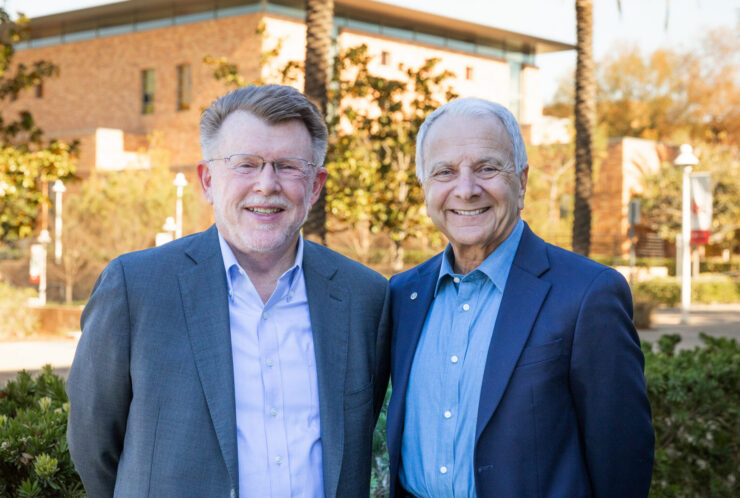
Photos by Andrew Castro
What began as a casual lunch invitation at Chapman University ultimately transformed a life, and now, through a philanthropic gift from Chapman Trustee and Professor Mark Chapin Johnson, Ph.D., will shape generations of Chapman students to come.
The Dr. James L. Doti Endowed Chair in Applied Critical Thinking—established through a $1 million gift—advances one of higher education’s most essential and increasingly endangered skills, the ability to think critically, question assumptions, and engage ideas with intellectual rigor and humility.
“The most important attribute in my life that I learned through this whole journey was critical thinking,” said Johnson. “The whole process of critical thinking is the legacy that Jim Doti left with me.”
“This gift goes to the very heart of what a Chapman education stands for,” said Matt Parlow, president of Chapman University. “Critical thinking is foundational to student success, and to see it being supported in such a meaningful way by a Chapman trustee who became a student as a part of his journey is an inspirational story. This endowed chair ensures that Chapman will continue to lead in cultivating critical thinking skills for generations to come.”
More than a financial contribution, the gift reflects a deeply personal story, one that speaks to the power of mentorship, the purpose of education, and Chapman’s mission to prepare students not just for careers, but for thoughtful, engaged lives.
 From Entrepreneur to Scholar: One Conversation That Changed Everything
At the time of their first encounter, Johnson was already a successful entrepreneur and civic leader. College, however, was not part of his story. That changed when Doti, then early in his presidency, made a habit of inviting leaders to campus for informal lunches.
During one such lunch, a lighthearted comment about taking a class quickly turned serious. Doti saw a lifelong learner already practicing critical thinking, even without formal academic training. Sensing that Johnson was entering a new chapter of life with more time and a desire to expand his horizons, Doti encouraged him to enroll in a course or two.
“I thought he would get more out of it than most people,” Doti said. “I said, ‘Why don’t you take a class and see where it leads?’”
What followed was unexpected: One class became many. Evening courses led to full-time study. Johnson eventually earned a bachelor’s degree from Chapman with three majors. That journey continued with a master’s degree and a Ph.D., driven not by professional necessity, but by a newfound love of learning.
“Jim saw something in me that I didn’t see in myself,” Johnson said. “He changed my life, literally, by putting me on a path I never imagined.”
Why Critical Thinking Matters Now More Than Ever
At the heart of the gift is a belief shaped through years of study. Success in business or life does not automatically equate to the ability to think critically. Through advanced academic work, particularly in history, political science, and comparative politics, Johnson came to understand how deeply assumptions shape beliefs and how rarely those beliefs are challenged. Critical thinking, he learned, is not about having the right answers. It is about asking better questions and being willing to accept that strongly held views may be wrong. That lesson, Doti noted, is precisely what higher education is meant to provide, especially at a time when its value is being questioned.
“There’s a major misunderstanding of what higher education is all about,” Doti said. “It’s not about a major, not about incomes or specific jobs. It’s about graduating as a lifelong learner and developing critical thinking skills that lead to greater understanding of the world and, with that understanding, greater joy in life.”
In an era defined by social media echo chambers, political polarization, and information overload, the need for those skills has never been more urgent.
“Technology has made it easier than ever to avoid ideas that challenge us,” Johnson said. “Critical thinking does the opposite. It forces us to confront complexity, nuance, and uncomfortable truths.”
Honoring a Legacy Through Teaching, Not Dogma
The Doti Endowed Chair in Applied Critical Thinking reflects Doti’s enduring educational philosophy: teach students how to think, not what to think.
“An endowed chair is one of the most meaningful gifts anyone can give to a university,” Doti said. “And to have one specifically focused on critical thinking is incredibly special. There are very few chairs like this. Yet when you think about it, that is the central purpose of higher education.”
The faculty member who holds the chair will bring critical thinking into the classroom through research, discussion, and practice, encouraging students to examine evidence, test ideas, and engage respectfully with differing perspectives.
“This chair isn’t about ideology,” Johnson emphasized. “It’s about intellectual discipline, curiosity, and the courage to question.”
For Doti, having his name associated with this mission is deeply meaningful.
“I’m honored that my name will be part of something so fundamental,” he said. “This is a statement that Chapman University is committed to what truly matters in higher education.”
Impact for Students and the Future of Chapman
For Chapman students, the impact of the gift will be both immediate and enduring. In classrooms shaped by the chair’s work, students will be challenged to move beyond certainty, wrestle with complexity, and develop habits of mind that last long after graduation. Those habits, analysis, empathy, skepticism, and intellectual honesty are foundational not only to professional success, but to citizenship in a democratic society.
Doti has seen that transformation firsthand. After completing his degrees, Johnson returned to Chapman and was appointed Presidential Fellow. As a faculty member, he teaches courses on constitutional principles, democracy, and civic understanding. Doti wrote in his recent book about his years as president at Chapman, “Mark has received among the highest student evaluations at Chapman.” His students often tell Doti that taking his class was one of the highlights of their Chapman experience.
“He’s a fabulous teacher,” Doti said. “Students used to come up and thank me for bringing him to Chapman. To see someone who had no formal college education come full circle, earning a Ph.D. and then teaching students how to think critically, that’s what the search for truth is all about.”
As Chapman looks ahead, university leaders see the gift as a powerful example of how philanthropy shapes institutional excellence and student opportunity.
“This endowed chair reflects the very best of Chapman’s philanthropic partnerships,” said Jessica Berger, executive vice president and chief advancement officer. “It advances academic excellence, honors extraordinary mentorship, and ensures that our students are equipped with the intellectual tools they need to navigate a complex world and contribute meaningfully to society.”