Brian Belardi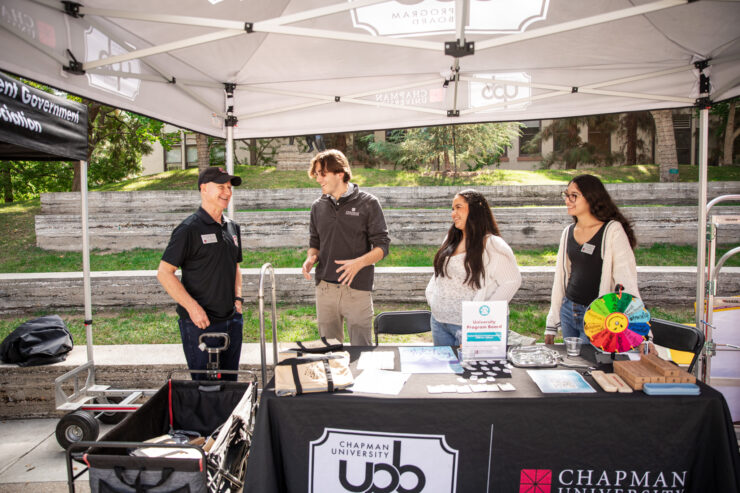
Making Room
With 200 student organizations competing for finite space, Chris Hutchison has spent 27 years building the infrastructure where Chapman students discover who they want to become.
Chris Hutchison oversees the spaces where Chapman University students choose to spend their time—recreation facilities, the student union, and 200+ organizations. He turns what can’t be done today into what might be possible tomorrow.
Hutchison’s office sits in an open workspace—rows of tables, undergraduate and graduate students at computers, student government officers and the University Program Board within two steps of his door. Every walk to the restroom includes conversations with students.
That proximity isn’t accidental.
When 200 Clubs Need Rooms
As Associate Vice President for Student Affairs and Associate Dean of Students, Hutchison and his team oversee wellness and recreation programs and facilities, the Argyros Forum Student Union, The Campus Center at Rinker, student involvement, student clubs and organizations, and fraternity and sorority life. He and his team advise four fee-funded student groups: Student Government Association, University Program Board, The Panther Newspaper, and Chapman Radio. Twelve professional staff members, 150 undergraduate student employees, and 10 graduate student assistants manage operations.
Hutchison maintains a to-do list of long-term priorities, but something always arises.
Fraternity leaders balance social activities with historic Orange neighborhood concerns. Student Government advocates for clubs asking for more program space. Organizations schedule around classes in shared buildings where noise can’t travel to the library, classrooms, or surrounding community.
“For me, it’s never ‘the answer is just we don’t have space, sorry,'” Hutchison explains. “If we can’t do something in the moment, it doesn’t mean we stop thinking about it or trying.”
That philosophy turns constraints into opportunities.
Finding Space in the Cracks
Student interest in pickleball grew over the last few years. No courts were available for student organizations to use. Clubs kept asking.
One of the basketball courts in the wellness and recreation facilities Hutchison’s team oversees needed repairs. His team saw something else: add pickleball lines when redoing the surface.
Now both basketball and pickleball are available. It didn’t require new construction or budget. It required watching for the right moment.
“It’s the immediate—maybe we’re not able to accommodate it,” he says. “But in short term, let’s see if we can get creative. And long term, what are we paying attention to that the campus can evolve to meet?”
Those solutions require collaboration beyond the daily work with colleagues throughout Student Affairs. Hutchison works with Athletics, Facilities Management on facility needs and evolution, Event Operations on navigating campus space and policy implementation, Campus Planning on long-term student needs. SMC, University Advancement, Enterprise Risk and Safety, IS&T, Financial Services, Human Resources—all partners in creating policies, responding to situations, looking ahead at possibilities.
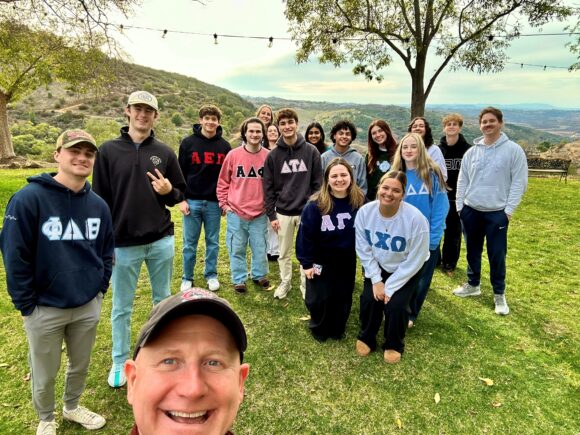
Tomorrow, the recreation team leads a hike to Idyllwild, a mountain community two hours away, for students to explore the outdoors at no cost.
But his work isn’t just about physical spaces—it’s about what happens in them.
Why Pictures Matter
“We’re not going to script every step of the journey for every individual student,” Hutchison says. “How do we facilitate spaces and experiences in a way that can help students find what that journey can include?”
His team designs the student union with specific purposes. Quiet areas let students sit among others without interacting. Group spaces offer games for downtime between classes. Rotating galleries on walls show current student life—people they know, activities they’re part of.
Working under Jerry Price, Senior Vice President for Student Affairs and Dean of Students, Hutchison delivers what Price describes as “engaging environments and meaningful experiences that facilitate learning outcomes”—developing meaningful relationships, respect for differences, and healthy sense of self.
“That matters to me,” Hutchison says. “It matters to people I work with, and I think it matters to the students, even if they wouldn’t begin to think that there were intentional conversations about what picture went where in a building.”
Student organizations used to vary in ambition. Now many expect to produce large-scale programs and build deep community. Students want to create experiences, not just participate.
Infrastructure has to keep pace.
The Accessible Administrator
Hutchison earned his undergraduate degree and MA in Leadership Studies from the University of San Diego, his MS in Educational Studies-Higher Education from the University of Oxford—one of two times he left Chapman—and his Ph.D. in Education from Chapman. He’s been at Chapman 27 years across three separate stints. First arrived in 1998 as an Assistant Director managing student activities. Left twice, returned twice. Now oversees the entire portfolio he once managed as one piece.
He also teaches—an additional opportunity beyond his administrative role—undergraduate and graduate classes in the Attallah College of Educational Studies leadership development program.
“The ability to build those interpersonal connections matters so much when we’re trying to address issues that are more complicated or challenging,” Hutchison explains.
Some things are difficult and challenging, but he can still laugh and smile with his team in the midst of those processes.
The Watch
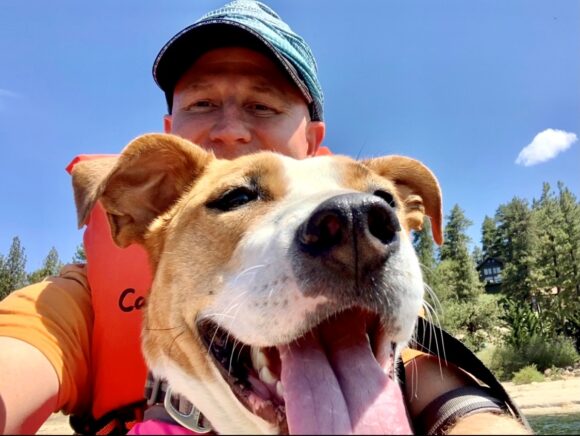
Hutchison carries a watch with rotating photos of Bella, his dog. Bella is a tripod dog—diagnosed with bone cancer 18 months ago, had her leg removed. She’s in a Yale vaccine trial for bone cancer developed by a Yale research team. The hope: it will eventually reach human application.
“Bella is a beneficiary of what higher education can bring,” Hutchison says. “Higher education made that possible. We do amazing things.”
When problems feel overwhelming: if she can navigate this, he can get through this problem. A reminder of why the work matters.
Looking Forward
Hutchison is building systems that will outlast him. Teaching graduate students who will work at other institutions. Creating frameworks that will serve students he never meets.
Twenty-seven years in, still watching for opportunities like pickleball courts.
The student body changes every four years. Needs shift constantly. Students focus on wellbeing differently, pay attention to societal issues in new ways.
He can’t get complacent.
He comes in every day wanting to build. Usually ends up responding. That’s okay—responding reveals what needs building.
“I believe so wholeheartedly in what higher education as a field can achieve,” Hutchison says. “It isn’t easy, but I don’t think it should be. The value and worth of what we do collectively just never ceases to amaze me.”