Nicole Bigley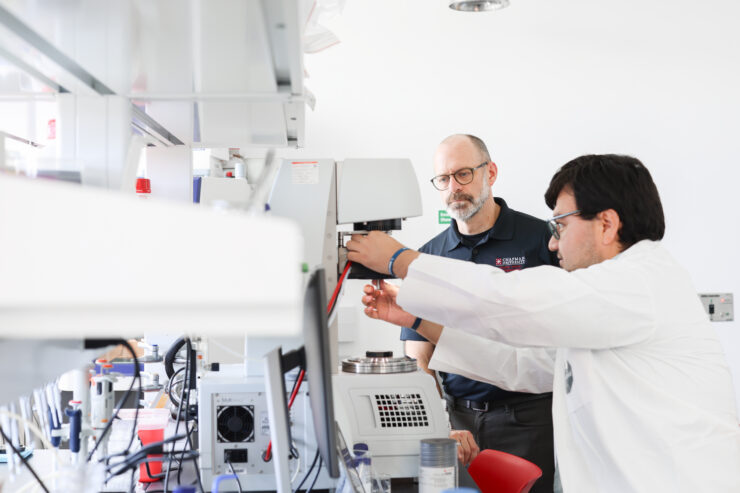
A team of Chapman University researchers – which included several undergraduates – has developed a new biomaterial that mimics the body’s natural tissue environment. The work is in its early stages, but the findings point to potential future applications in wound healing and tissue repair.
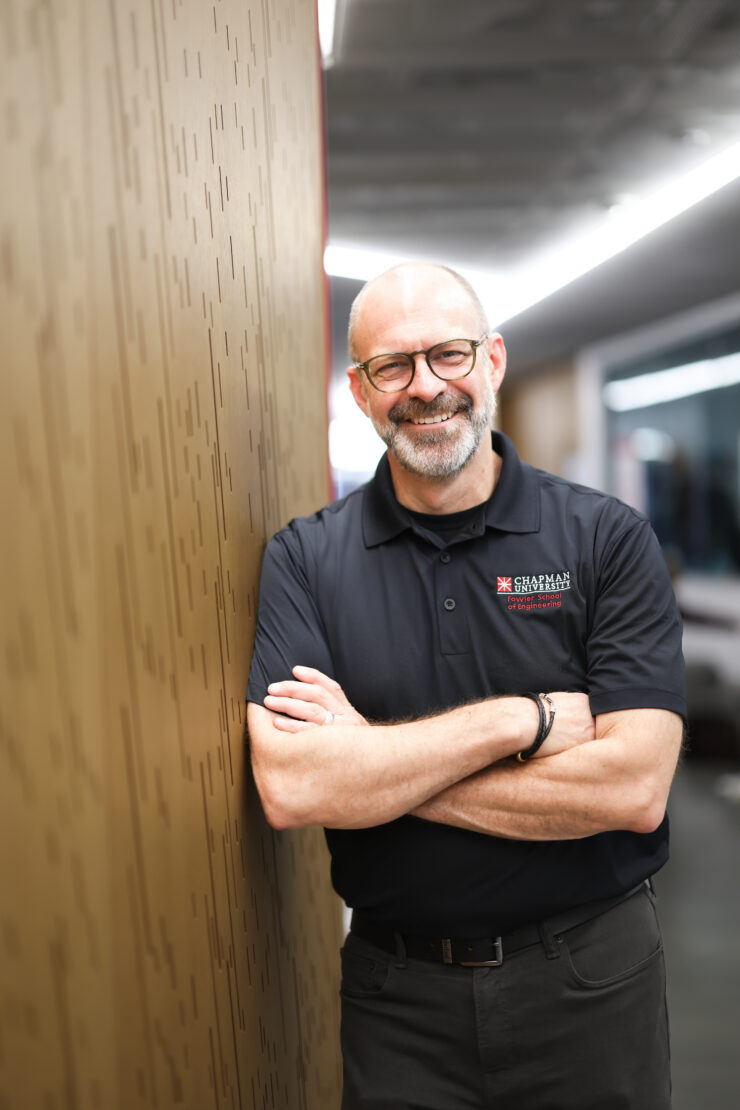
The study, published in the journal Advanced Materials, emerged from years of experimental work led largely by undergraduate researchers in the biomaterials lab of L. Andrew Lyon, Ph.D., a professor of chemistry with a joint appointment between Schmid College of Science and Technology and Fowler School of Engineering.
Materials designed to promote healing often face a tradeoff: They can be strong enough to support tissue growth or soft enough for cells to move through, but rarely both. Lyon’s team developed an injectable paste that appears to do both at once. During laboratory testing, living cells moved into the dense material and continued growing. The material also reorganized itself at a microscopic level, behaving more like living tissue than traditional synthetic materials.
The research is still years away from clinical use, and Lyon said the team is focused on understanding how the material behaves before targeting specific diseases or injuries. Future applications could eventually include cartilage repair, reconstructive surgery, spinal cord injuries, or cardiac tissue repair.
Many of the study’s authors began this research as undergraduate students, including two co-first authors who shared primary responsibility for the experiments, analysis, and writing behind the study. Lyon’s lab is part of a broader culture of undergraduate research at Chapman, where students are encouraged to participate directly in faculty scholarship and long-term scientific discovery.
“The conversations I was having with them were deep intellectual conversations where they were collaborators and intellectual partners in the work,” Lyon said. “That level of ownership is unusual for undergraduate students.”
The project evolved over several years as students graduated and new researchers joined the lab. Among the most prominent contributors were:

Sanika Pandit ’22, co-author, was among the earliest student researchers on the project. Now pursuing a Ph.D. at the Lampe Joint Department of Biomedical Engineering at North Carolina State University (NCSU) and the University of North Carolina at Chapel Hill, where she holds a National Science Foundation Graduate Research Fellowship.

Elif Narbay ’23, co-first author, developed the foundational protocol for forming collagen gels and integrating microgels into the system. Now a research associate in Lyon’s lab, where she continues work on the next iteration of the project and mentors current undergraduate researchers. She will pursue a Ph.D. in biomedical engineering at University of California, Santa Barbara this fall.
Abbygail Caine ’25, co-first author, led the key experiment triggering collagen self-assembly inside the microgel composite. Now pursuing her Ph.D. at the joint Lampe Department of Biomedical Engineering at NCSU and UNC Chapel Hill, where she also holds a National Science Foundation Graduate Research Fellowship.
Reflecting on Pandit and Caine’s success, Lyon noted that it’s difficult to get into these high-caliber Ph.D. programs without having come from a biomedical engineering undergraduate program. “I’m really proud of them.”
The remaining student co-authors are Gabrielle Montgomery ’25, Marion Harper ’27, Hatte Hamilton ’26, Megan Hicks ’26, and Kyle Choy ’24. They are joined by Grand Challenges Initiative Fellow E. Daniel Cárdenas-Vásquez and Marco Bisoffi, Ph.D., an associate professor who holds appointments in Schmid College of Science and Technology, Crean College of Health and Behavioral Sciences, and the School of Pharmacy.