Brian Belardi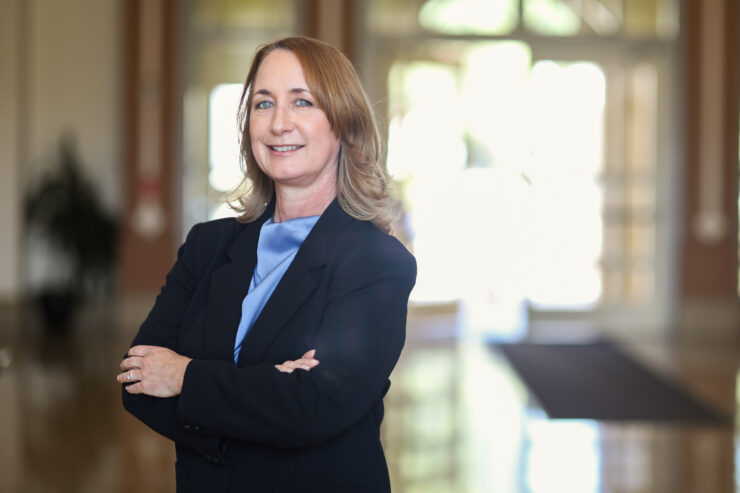
In a seminar room this fall, a biochemist, a business major, a dancer, and a dozen other students will wrestle with a question none of them could answer alone: How do you rebuild public trust in science?
No single discipline can solve it. That’s the point.
The class is part of Chapman University’s Honors Program, which has drawn students from every corner of the university into small, discussion-based seminars since 1982. About 275 students are enrolled today, taking roughly two honors courses a year alongside their regular coursework, and finishing with an original research project. Students apply to the program during the admissions process; transfer students can participate on an abbreviated track. Continuing students may apply on a space-available basis.
For decades, the program has sent curious, wide-ranging thinkers out into the rest of the university. New director Tara Gruenewald, who took over in September 2025, wants the rest of the university to start sending its hardest problems back.
“It’s about helping our students see themselves differently,” said Gruenewald, Ph.D., MPH, a psychology professor in Crean College of Health and Behavioral Sciences. “And it’s also about helping our faculty and administrators see the honors program differently.”
University Honors Program
- 275 students university-wide
- 8 courses over four years, culminating in a senior research project
- Small, discussion-based seminars of approximately 15 students
- Open to incoming first-year and transfer students; continuing students may apply on a space-available basis
- Priority application deadline: March 31
- Learn more: University Honors Program, DeMille Hall 108
A social and health psychologist, Gruenewald led Chapman’s psychology department for eight years before taking on the honors directorship last fall. Her research focuses on generativity — the science of how contributing beyond yourself turns out to benefit the giver as much as the recipient. A person who mentors others gains as much as the people they mentor. A community that invests in its members gets back more than it puts in. It’s the same logic she’s bringing to honors.
“Tara’s commitment to academic excellence, comprehensive student development, and cross-disciplinary collaboration will be instrumental in shaping the next chapter of the University Honors Program,” said Mike Ibba, Ph.D., executive vice president, provost, and chief academic officer. “We are excited to see the program grow in both size and reputation.”
Gruenewald is spending her first academic year rethinking the program’s role on campus — building partnerships with research institutes and redesigning the first-year curriculum so students encounter research from the very start.
Research From Day One
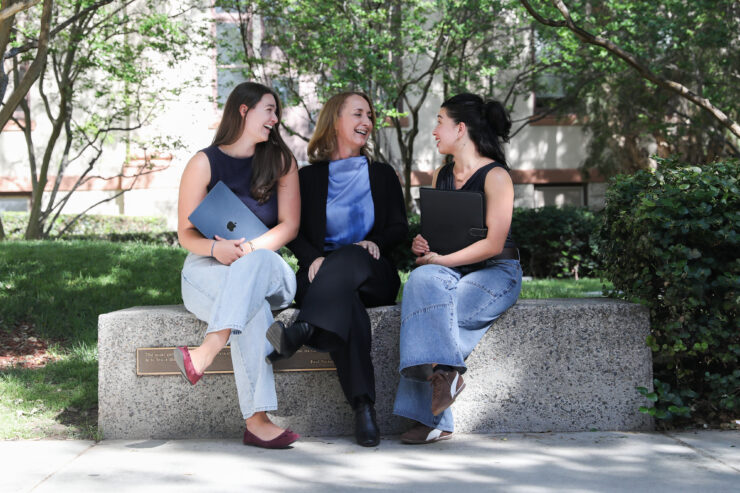
One of Gruenewald’s first priorities is redesigning Honors Forum, the seminar all incoming honors students take in their first year. She wants students to begin asking not just what scholars have discovered, but how they discover it, and where they themselves might fit in. By the time students reach their senior research project, the work should feel like a natural next step and not an entirely new demand.
Students already feel the difference.
Nichole Wheeler, a junior human physiology major, has been in honors since her freshman year at Chapman. She came in as a psychology major and switched, but honors, she says, has been the one constant. The program has opened doors to the kinds of intellectually engaging classes that complement her regular coursework.
“My major focuses on how the body functions to maintain life,” said Wheeler, who is taking a seminar this semester on death, self, and society. “But my honors course was the one to actually fill in the gap by exploring what death means culturally, socially, and individually.”
This summer she will lead a SURF — Summer Undergraduate Research Fellowship — project examining how neurobiological stress affects people’s ability to maintain healthy behaviors, focusing on executive function as a key underlying mechanism. Rather than viewing difficulties with medication adherence or exercise as failures of willpower, her research explores how chronic stress disrupts the cognitive processes essential for behavior regulation. Gruenewald is her faculty mentor.
A Wider Circle
This year Gruenewald has been building partnerships with research institutes and centers across campus, looking for places where honors students and faculty can do work that benefits the broader university.
The Ferrucci Institute for Italian Studies now funds a research award for honors students in Chapman’s Italy travel courses. The institute gets promising scholars in its pipeline, and honors students get funded research opportunities. This spring, Gruenewald launched Critical Conversations, a faculty discussion series that pairs professors from different disciplines for public conversations on real-world topics, creating connections across departments.
Wheeler carried that cross-disciplinary spirit when she designed and taught her own honors course — a preceptorial, in honors parlance — titled “Cut Me Open: A Deeper Look at the Portrayal of Surgery in Film, Art, and Literature.”
Working with faculty mentor Manjari Murali, Ph.D., an assistant professor of health sciences, Wheeler built the syllabus from scratch, leading students through case studies comparing how shows like Grey’s Anatomy and The Pitt depict health care, and what those representations mean for public perception of medicine.
“Having the opportunity to teach a whole class opened my eyes to the logistical side of putting a course together and definitely helped with my communication and organizational skills,” she said.
In year two, Gruenewald plans to spend less time revitalizing operational processes and more time in other people’s offices, learning what colleagues across Chapman’s campuses actually need from honors.
Snacks and Puppy Moments
The program’s appeal isn’t only academic.
The Honors Commons, a bright and open lounge in DeMille Hall, has become something of a home base for students between classes. Both Dr. G and Ashley Cosgrove, the program’s specialist and coordinator, keep their doors open, and students keep walking through it. There are free snacks and on good days, senior Elize Itkis’s homemade bread. Occasionally, an honors alumnus drops by with foster puppies and kittens, which triggers an alert in the program’s student group chat.
“The people in honors make the whole program, to be honest,” Wheeler said. “I don’t think I realized how much I needed the program, not only for my social connections, but also for the way we approach classes and our assignments.”