Cristine Hall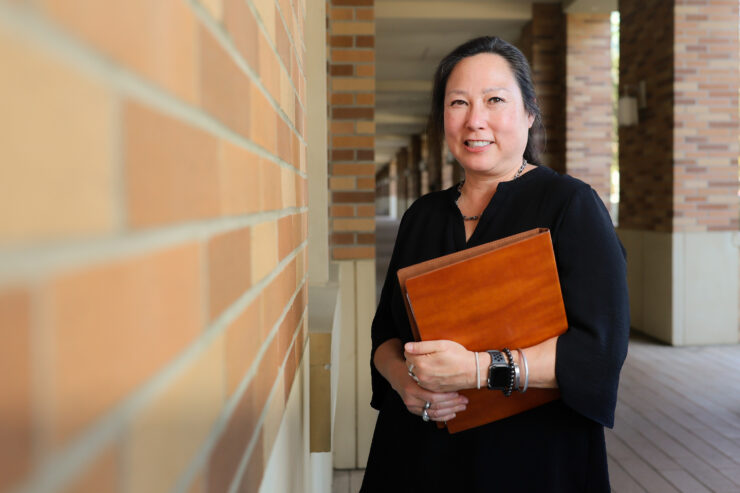
Stephanie Takaragawa builds her classes around the world students already inhabit — the food they eat, the neighborhoods they wander, the pop culture they consume — and then teaches them to read that world like a text.
In past years, the cultural anthropologist led students through the ethnic enclaves of Little Tokyo and Olvera Street to examine how migrant communities build identity from place and took them to Disneyland to study why the park makes people behave the way it does.
This semester she launched “From Chop Suey to the Kogi Taco Truck: Asian American Food and Identity,” exploring what Asian American food reveals about immigration, war, and cultural reinvention, from the unlikely journey of Spam to the invention of the California roll. Her courses, which carry heavy reading loads, are not easy. Students line up anyway.
“I want students to think about how what they’re doing every single day is shaping the culture that they’re in,” said Takaragawa, associate professor of sociology and associate dean for academic programs at Wilkinson College of Arts, Humanities, and Social Sciences. “I want them to learn who they are and what they believe in.”
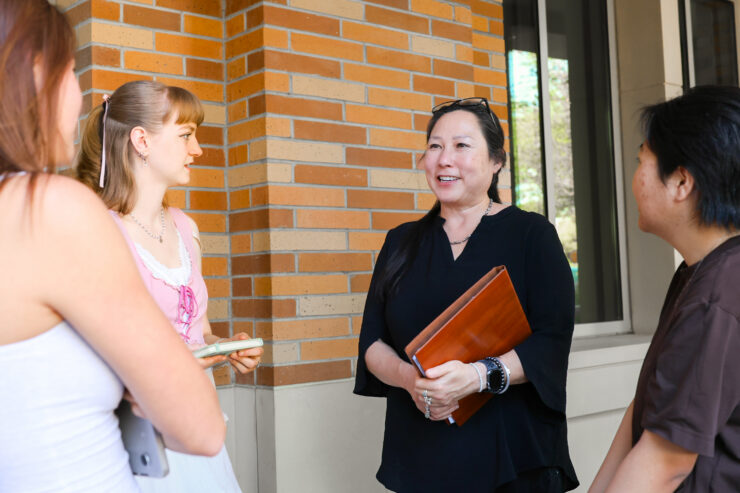
Takaragawa grew up in Midtown Los Angeles in a multicultural, working-class neighborhood that her parents’ generation knew as a hub of Japanese American life. Under Los Angeles’s desegregation busing program, she was picked up at 6:30 every morning and driven to school in Bel Air — a jarring daily crossing between two worlds that made her acutely aware of race, social class, and identity before she had the vocabulary to describe any of it.
“The busing system really made my understanding of the world much more complicated early on,” she said. “Which may be why I became an anthropologist.”
She went on to study anthropology at USC and earned her Ph.D. from Temple University, writing her dissertation on the Japanese American National Museum. She first encountered the museum as a volunteer before it even opened, when it held education programs out of a small Buddhist temple.
That connection to the museum was personal in ways that took years to fully understand. Takaragawa’s father was born at Heart Mountain, a Japanese American incarceration camp in Wyoming. Her family, like many in that generation, did not talk about it. She didn’t learn about it until college.
One of Stephanie’s greatest superpowers is her ability to talk with, listen to, and think about students and their personal journeys here. She highlights the best of what a personalized education at Chapman offers.” — Charissa Threat, Associate Dean for Students and Faculty Advancement, Wilkinson College
It was only when her grandmother visited the museum and began, for the first time, to speak about her experience that Takaragawa understood what the right environment could unlock. All four of Takaragawa’s grandparents were interned. That insight sits at the center of everything she studies.
“What I’m really interested in is how different environments impact the way that you behave,” said Takaragawa, who is also director of Asian American Studies, Ethnic Studies, and Health Humanities. “What is the case with museums? What is the case with Japanese American internment camps? How is it that your environment shapes your behavior, your expectations — and yourself?”
It’s a question she will soon have more time to pursue. This semester, Takaragawa will step down as associate dean, freeing her to return to “Comics and Camp,” a grant-funded investigation into how World War II-era comic books shaped public perception of Japanese American internment.
Her previous research uncovered a troubling disconnect. In focus groups conducted with middle and high school students, every single respondent said Japanese Americans were interned because they were spies. In reality, not one internee was ever found to be a spy.
Takaragawa believes popular culture — including a comic strip of Superman rooting out Japanese American spies in the camps — helped cement that myth in the public imagination.
For Takaragawa, that history has always been personal — and so has Orange. She has called the city home for years, and its charms have proved contagious. She met her husband, economist Steven Gjerstad, when they both taught in the Chapman honors program in 2012. Her niece is a Chapman student, and her parents, who recently moved from Pasadena, live nearby.
That sense of connection extends into her classroom. When she learned a student from Hawaii was homesick, Takaragawa made Spam musubi, a beloved Hawaiian staple of rice and canned meat wrapped in seaweed, for a campus potluck. The gesture said your culture, your history matter here.
“I just like being in this community,” she said. “It’s like an extended family.”