Cynthia Rebolledo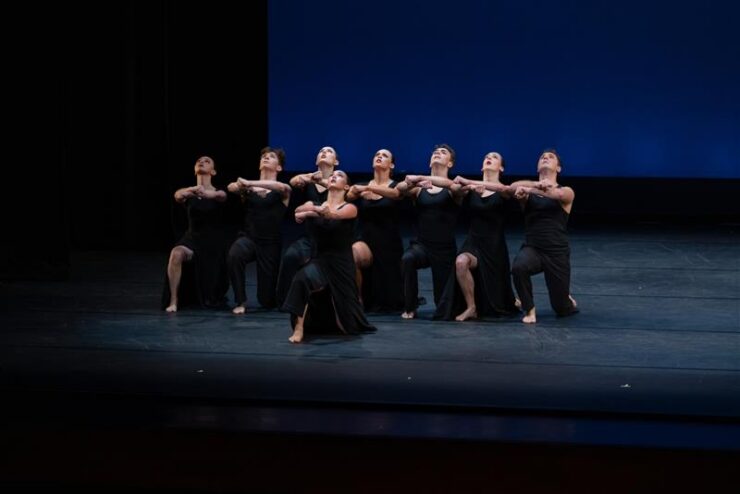
Nearly a century after it was first choreographed, a dance about exile and unrest found new life at Chapman University.
Twelve student dancers stepped onto the stage at the Marybelle and Sebastian P. Musco Center for the Arts to perform “Steps in the Street” on Feb. 11 during the centennial season of the world-renowned Martha Graham Dance Company. They were joined by 34 student musicians from The Chapman Orchestra (TCO).
The performance gave students in the College of Performing Arts a rare opportunity to work directly with one of the most influential companies in modern dance. Over several months, dancers trained, rehearsed, and performed under the guidance of members of the Martha Graham Dance Company as it marks its 100th anniversary season.
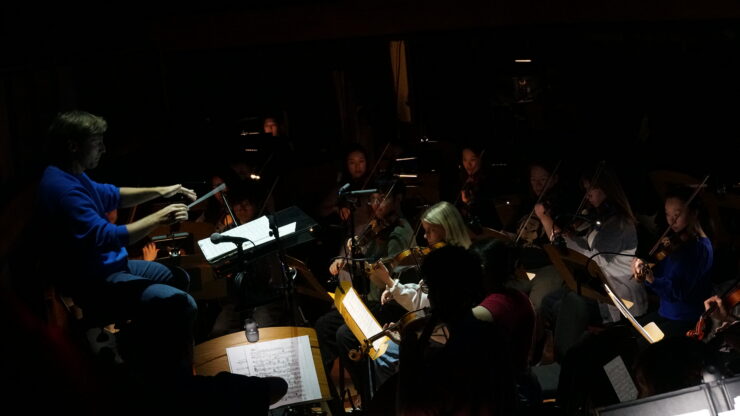
The evening’s programming wove together historic and contemporary works from the Graham repertory. In the pit, student musicians from TCO performed much of the score live under the direction of Danko Druško, Ph.D., assistant professor of orchestral studies, conductor, and director of TCO.
“This is a really unique opportunity for the orchestra students and for the dancers because it’s less common to have an orchestra accompany,” Druško said. “To have live music — like an organism that breathes — rather than a recording that’s just being played for you makes this production special.”
For 19-year-old cellist Maia Werner, the performance was her first time playing in the pit.
“I remember I would go see operas and ballets as a kid, and I always got really excited about peering into the pit,” said Werner, a sophomore studying cello and orchestral conducting. “Now, I’m the one in there, so this really feels like a full-circle moment for me.”
For the student dancers, performing the piece challenged them to master its physical rigors and connect to a lineage of artistic inquiry that foregrounds dance as a means of grappling with the human condition.
In the final weeks before the performance, they worked closely with Peter Sparling, an authorized stager of Graham’s choreography, who traveled to campus to refine the piece and prepare it for performance. Sparling said that Graham challenged the human body to do extraordinary things.
“She believed that by activating the deep recesses of the body and all its connectivity, one could access what she called ancestral memory,” Sparling said. “That all of us humans are born with deep body knowledge that goes way back and informs us behaviorally and how we react emotionally to situations.”
Anne Hogan, Ph.D., dean of the College of Performing Arts and the Musco Center for the Arts, said collaborations like this reflect Chapman’s commitment to presenting world-class artists while creating meaningful opportunities for students.
“It’s about bringing top-quality companies to perform at Musco for our students and the wider community,” Hogan said. “At the same time, it’s an amazing opportunity for our students to learn directly from those artists and share the stage with them.”
For the dancers, that meant mastering choreography known for its weight and physical intensity. First created in 1936 as part of the larger work, “Chronicle,” “Steps in the Street / Devastation–Homelessness–Exile,” was a response to the rise of fascism in Europe. Performing it required not only stamina, but a willingness to inhabit the emotional demands of the work and connect to a lineage that has shaped modern dance for nearly a century.
“As sad and beautiful as it is, we get to bring this piece back from the ’30s,” said Mandy Fang, 21, a double major in dance performance and public relations and advertising.
“Steps in the Street” is only 10 minutes long, but every moment of the dance is an athletic feat, requiring steps that are heavy, grounded, and deliberate. The choreography does not sentimentalize suffering; it emphasizes endurance.
“I’ve seen the students, in a short amount of time, get stronger and adapt really beautifully,” said Julianne O’Brien, associate dean and rehearsal director. “I’m very proud of them.”