 Nicole Bigley
Joe Chantry ’14 arrived at Chapman with a scholarship and a clear destination: Hollywood. He didn’t expect a collegiate dance program to reshape him or a cruise ship to become his stage. But Chapman, it turns out, has a way of rewriting the itinerary.
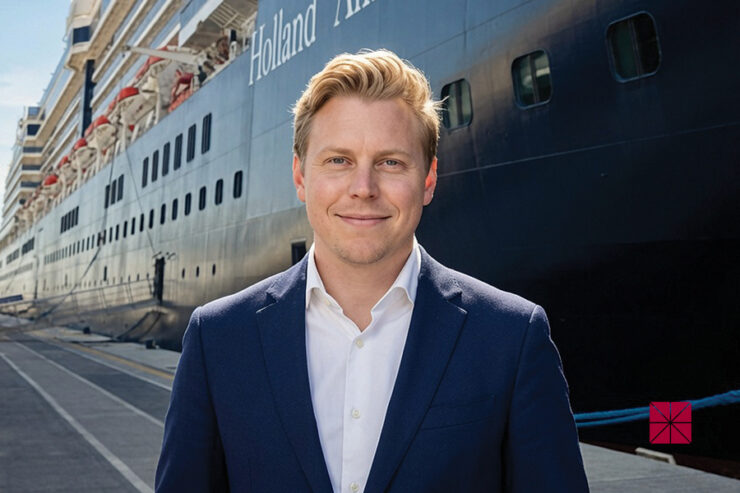
Today, Chantry is vice president of entertainment and enrichment at Holland America Line and Seabourn, overseeing entertainment across a fleet of 17 ships.
His journey is a case study in what a performing arts education can prepare you for — and it’s more than most people expect. The discipline, adaptability, and emotional intelligence that Chapman’s dance program instilled made him a better performer and laid the foundation for an executive career that has weathered professional pivots and unexpected adversity. Among the most defining: losing his hearing before 30, a turning point that forged him as a leader and an advocate.
“The dance program went beyond preparing dancers for the stage,” said Chantry, who works at the company’s headquarters in Miami. “It went deep into history, pedagogy, and somatic psychology, and I started asking how dance could do real work in the world.”
MOVEMENT WITH MEANING
Growing up as a competitive dancer in Dallas, Chantry chose Chapman for its dance program and financial support. He didn’t anticipate the university’s commitment to producing something larger than skilled performers — graduates who could engage with the world beyond the stage.
A freshman-year Introduction to Peace Studies course, taken mostly out of curiosity, inspired the pursuit of a double major in Peace and Conflict Studies. Far from pulling him away from dance, it sharpened his sense of what movement could do.
His senior thesis proposed a non- governmental organization that would use dance/movement therapy to help adolescents in underserved communities process trauma and other risk factors through movement — an early sign of how he would merge artistry and purpose in his leadership career.
WHAT THE STAGE ACTUALLY TEACHES
Ask Chantry which skills from his performing arts training proved most valuable in executive leadership, and he doesn’t hesitate. The answers — discipline, self-evaluation, emotional intelligence, social adaptability — are qualities, he argues, that the performing arts develop with unusual rigor.
“Dancers live in front of a mirror, for better and worse,” he said. “You’re constantly forced to self-evaluate and correct. In leadership, I always go inward first — asking myself what I could do better or differently to affect a different result. And dancers know how to ‘take a note.’”
Years on stage don’t eliminate nerves, but they do build mental discipline and thick skin. Dancers learn to take criticism, internalize it, and make the result look effortless even when it isn’t.
Then there’s the social dimension. Performing arts demands constant adaptation: new choreographers, new casts, new styles, new roles. That constant shapeshifting, he said, translates directly into his work balancing the creative and operational components of leading a complex, global entertainment operation.

THE TIP THAT CHANGED EVERYTHING
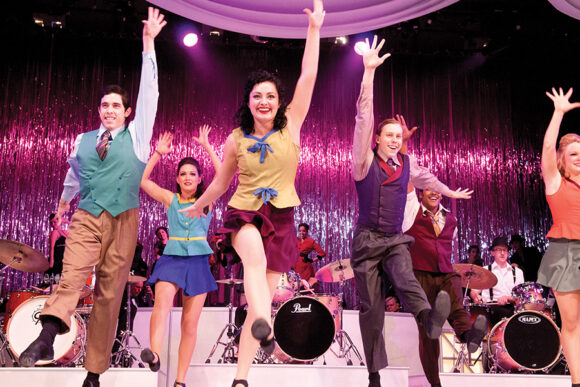
After Chapman, Chantry pursued the career he had planned — auditioning and teaching in Los Angeles, eventually landing a coveted spot in a Las Vegas production where he performed six nights a week alongside a 32-piece live orchestra and 36-person cast of singers and dancers.
A friend who had danced for Holland America made a suggestion: Ship life, the friend promised, was a rare chance to travel, save money, and think clearly about what came next.
The real turning point came in 2017, aboard the Holland America-operated Eurodam, where he was serving as dance captain. When a Holland America executive came aboard for a routine town hall, Chantry raised his hand during the Q&A, offering practical ideas about improving the guest experience and strengthening creative- technical collaboration. The executive asked for a follow-up meeting and stayed in touch.
The rest moved quickly. Within a year, Chantry became production manager. By the end of 2018, he was in Seattle overseeing casting, technical, and financial operations. Seven-plus years later, he holds the VP title.
LISTENING DIFFERENTLY
The most defining chapter in Chantry’s career is also the most personal. At the age of 20, he began to lose his hearing — a genetic vulnerability compounded by years in the loud environments that define a dancer’s life. He lost a significant portion during his Las Vegas run, performing nightly in front of a live orchestra without adequate protection. By 30, he was deaf.
Hearing aids provided some relief until the pandemic arrived, the world masked up, and lip reading became impossible. A cochlear implant in late 2020 changed everything, allowing him to function fully in professional settings.
The experience transformed him as a leader. Holland America’s technicians now monitor decibel levels in every live entertainment venue. Performers working near live music are equipped with protective gear that reduces decibel levels without distorting sound. “We keep the volume below the harmful threshold as best we can,” he said. “That’s non-negotiable for me.”
The value and impact of that well-rounded Chapman education will prove its worth over and over again.”
— Joe Chantry ’14, vice president of entertainment and enrichment at Holland America Line and Seabourn
PAYING IT FORWARD
Holland America has hired multiple Chapman graduates over the years, and Chantry is deliberate about keeping the pipeline open. He has posted job listings through Chapman alumni networks because he remembers being a young performer with no map of where the industry could actually take him.
“Many performing artists aren’t even aware of the different opportunities and tracks within the entertainment business,” he said. “So, I’d go into the social networks and post job listings just so people could see a dancer doing something different, and this path exists.”
What he notices in Chapman graduates traces back to the rigor of the education itself. Even in the dance program, students were expected to research, write, and think critically. That intellectual foundation shows up in how Chapman alumni solve problems, communicate, and grow. The difference between who he was at 18 and who he was at 22 when he left Chapman is not lost on him. “The value and impact of that well- rounded Chapman education,” he said, with the certainty of someone who has lived it, “will prove its worth over and over again.”