 Cynthia Rebolledo
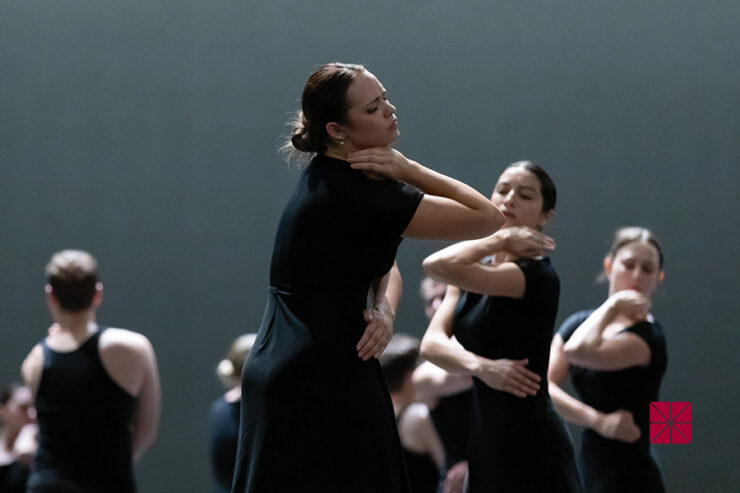
Twelve dancers in long black dresses move across the stage at the Marybelle and Sebastian P. Musco Center for the Arts, their steps heavy and deliberate. One by one, they disappear into the wings — until a single figure remains. She moves with measured steps, then halts before her arms rise and open above her head. The orchestra erupts.
The performance was “Steps in the Street,” Martha Graham’s 1936 response to the rise of fascism in Europe, a work about the devastation, exile, and the lone individual who refuses to be consumed by it. The dancers on the stage were Chapman University students performing alongside the storied Martha Graham Dance Company, celebrating its centennial season, while 34 student musicians from The Chapman Orchestra performed the score live from the pit.
It was exactly the kind of collaboration Chapman has built its arts programming around — bringing world-class artists to campus while creating meaningful opportunities for students. The deep professional networks of Chapman faculty made it possible: Julianne O’Brien, associate dean of the College of Performing Arts (CoPA), had danced for 14 years under Peter Sparling, the authorized stager of Graham’s choreography who came to campus to prepare the students for the performance.
“It’s about bringing top-quality companies to perform at Musco for our students and the wider community,” said Anne Hogan, Ph.D., dean of CoPA and Musco Center. “At the same time, it’s an extraordinary opportunity for our students to learn directly from those artists and share the stage with them.”
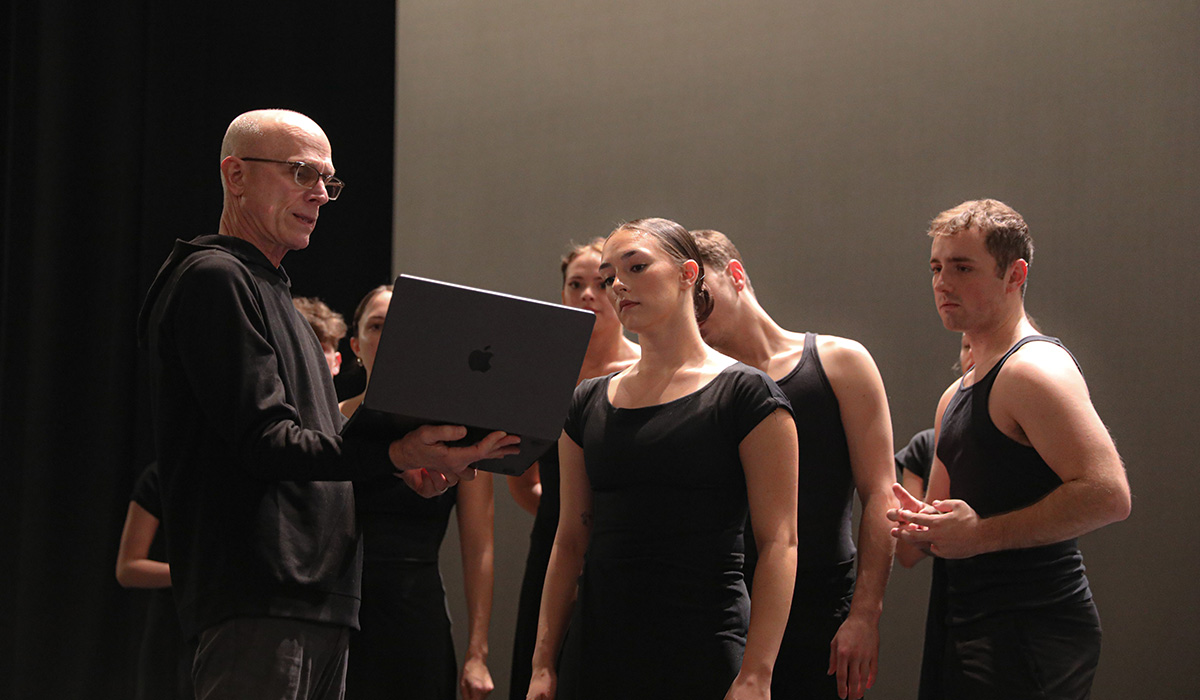
The collaboration began in spring 2025, when O’Brien held auditions and sent video of the dancers to the Graham company’s rehearsal director, who selected 12 students and two understudies. That fall, O’Brien taught the cast a semester of Graham technique — the rigorous, grounded vocabulary of contraction and release that defines the company’s movement language — before rehearsal director Elizabeth Auclair arrived in January to stage the work with the students.
For senior Charley Teltschik ’26, the process demanded something unfamiliar.
“Most of us grew up as precision dancers with the choreography really specific and clean and exactly the same as everyone else,” said Teltschik, who is double majoring in data science and dance. “This dance really challenged us to dive deeply into our muscles where the energy comes from, central to the core, where our emotions are deep-rooted. I feel like it’s really improved my relationship with myself and my synergetic connection with the other dancers.”
“This dance really challenged us to dive deeply into our muscles where the energy comes from, central to the core, where our emotions are deep-rooted. I feel like it’s really improved my relationship with myself and my synergetic connection with the other dancers.”
— Charley Teltschik ’26
In the final days before the performance, Sparling arrived at Chapman to refine the piece for the stage. Building on the foundation set by Auclair, he gave them imagery to drive home the original intention of the work, “so that they are fearless and that they go all the way within the container of the body.”
“[Graham] believed that by activating the deep recesses of the body and all its connectivity, one could access what she called ancestral memory,” said Sparling, a dancer and choreographer who is the Rudolf Arnheim Distinguished University Professor Emeritus of Dance and Arthur F. Thurnau Professor Emeritus at the University of Michigan. “That all of us humans are born with deep body knowledge that goes way back and informs us behaviorally and how we react emotionally to situations.”
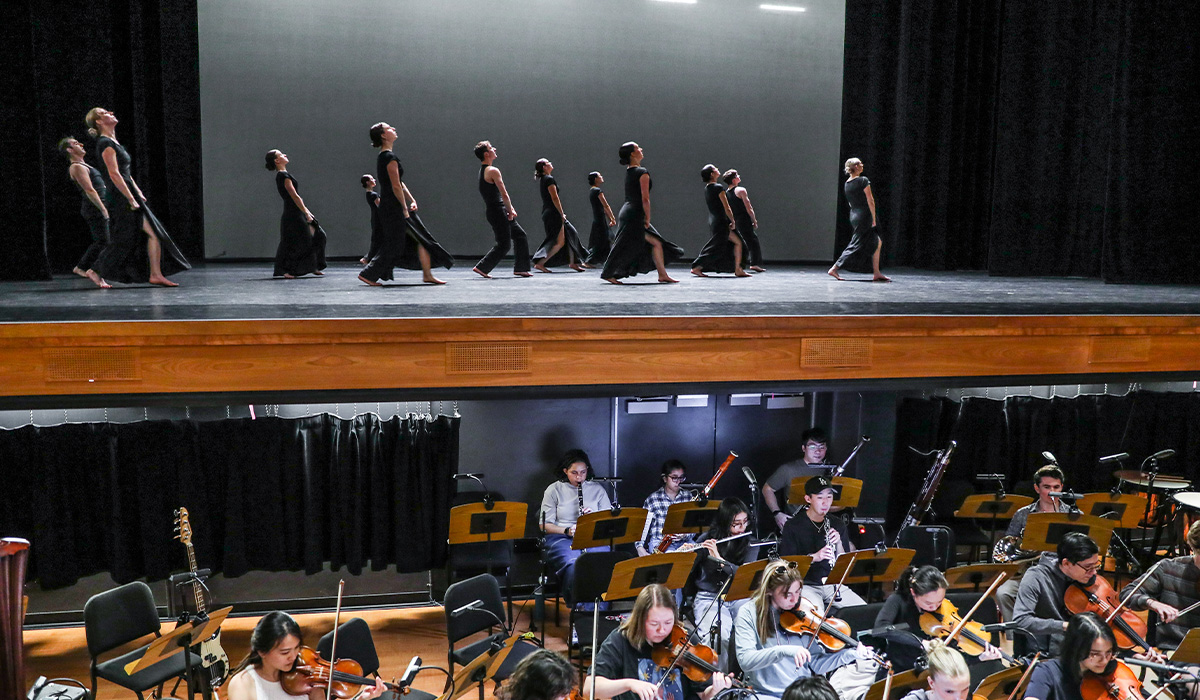
In the pit, student musicians performed the score live under the direction of Danko Druško, Ph.D., director of orchestral studies and conductor of The Chapman Orchestra.
“This is a rare opportunity for the orchestra students and for the dancers because it’s less common to have an orchestra accompany,” Druško said. “To have live music — like an organism that breathes — rather than a recording that’s just being played for you makes this production special.”
 It was cellist Maia Werner’s first time playing in the pit.
“I remember I would go see operas and ballets as a kid, and I always got really excited about peering into the pit,” said Werner ’28, who is studying cello and orchestral conducting. “Now, I’m the one in there, so this really feels like a full circle moment for me.”
Graham founded her company in 1926, at a time when classical ballet dominated American stages. She distinguished herself by forging an emotionally driven approach to movement that sought to express the inner life of the human spirit rather than its ethereal surface. Over a career spanning more than half a century, she created more than 180 works, collaborating with composers, visual artists, and designers to unify dance, music, and theater into powerful theatrical statements.
“Steps in the Street / Devastation–Homelessness–Exile,” first created as part of the larger work Chronicle, requires not only stamina but a willingness to inhabit the emotional demands of the work and connect to a lineage that has shaped modern dance for nearly a century.
“As sad and beautiful as it is, we get to bring this piece back from the ’30s,” said Mandy Fang ’26, a double major in dance performance and public relations, advertising, and entertainment marketing, with a minor in Asian American studies. “Steps in the Street” is only 10 minutes long, but every moment of the dance is an athletic feat requiring steps that are heavy and deliberate. The choreography does not sentimentalize suffering. It emphasizes endurance. “I’ve seen the students, in a short amount of time, get stronger and adapt really beautifully,” O’Brien said. “I’m very proud of them.”