 Matthew Watson
When Chapman President Matt Parlow delivered his first State of the University address in February, he spoke about the theme of “Continue” — plans to continue the institutional momentum driving the university’s upward trajectory, as well as Parlow’s intent to continue the strong leadership precedent established by the long-term presidents before him.
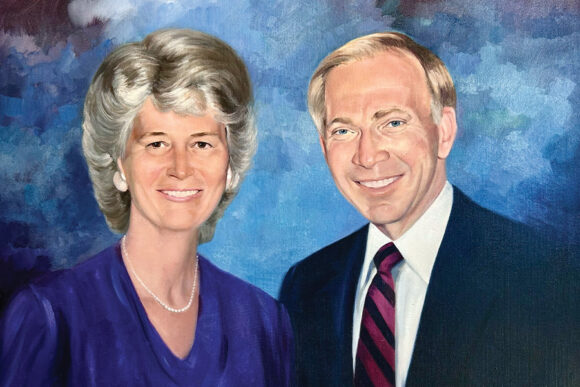
While most members of the Chapman community are familiar with Presidents Emeriti Daniele Struppa and Jim Doti, who are still very active at the university and in Orange County, fewer know the story of President Emeritus G.T. “Buck” Smith, who brought Chapman back from near-bankruptcy in the 1970s and ’80s. Fewer still know about his role in shaping Chapman’s presidential lineage — or the late-night dumpster dive that set it all into motion.
EARLY BEGINNINGS
Smith graduated from the College of Wooster and Cornell University, then began his career in higher education at Cornell in 1960. He returned to Wooster in 1962 as a fundraising vice president, where he proved so successful that he began consulting for other institutions struggling financially. Enter Chapman College, which was millions of dollars in debt when it hired Smith as a consultant in 1976.
On a campus visit, Smith was greeted by an old gymnasium that had been condemned. Chapman had begun demolition but ran out of funds to finish the job.
“I could see why they were going out of business. The building in the center of campus was boarded up,” Smith said.
Smith met with George Argyros ’59, who had just been named chair of the Board of Trustees, and gave him a blunt assessment about how much Chapman needed to fundraise to fix the building and who should give first: Argyros himself. Argyros agreed, and he and Smith met with other board members until they had close to $1 million in commitments for what would become the Harold Hutton Sports Center. The facility would be much more than a gym.
“People thought Chapman was going under, but the groundbreaking was a sign of hope,” Smith said.
THE RECOVERY THAT ALMOST NEVER WAS
Argyros and the board thought so much of Smith that, in 1977, they appointed him Chapman’s 10th president, a position he held until 1988. Under Smith’s leadership, Chapman’s net worth tripled from $7 million to $21 million, while enrollment increased 50% and applications tripled.
The secret to success was aligning the institution’s mission and operations, as Smith would tell the Los Angeles Times in 1985: “The spirit of the place needed to be captured in certain values and principles that would guide the thinking, actions and programs of the campus community.”
But the presidency that helped Chapman recover almost never happened. As a consultant, Smith thought he was finished with Chapman and tossed all his files in the garbage. It was his late wife, Joni, who had a bad feeling about it and made Buck dig the files out with a flashlight in the middle of the night. Four months later, he became Chapman president, a job he didn’t even know he was a candidate for that night.
A CARETAKER AND PERSUADER
As president, Buck was often in the weeds quite literally. He was known for picking up trash on campus and once even tossed a wayward hamburger that was part of a student art installation in the Guggenheim Gallery.
A story Buck loved to tell parents involved his surefire way to get students to call home: Write your student a letter acknowledging that the transition to college can be difficult, and that there can be unexpected expenses. Then mention you’re enclosing a check, but don’t actually include one. “You’ll hear from them right away,” he said.
As first lady, Joni attended a student event on campus almost every day, and the Smiths often hosted events for Chapman students and parents in their home. Smith Hall on the Orange Campus is named in honor of Joni and Buck and the key role they played in helping turn Chapman around.
One of Buck’s most important contributions to Chapman was a critical dean hire. It was Buck who appointed a young Chapman business professor named Jim Doti to become the business dean in 1985. Doti had little interest in administration at the time, but Buck persuaded him and became his mentor.
After the brief and challenging presidency of Allen Koenig from 1989-91, Doti served as president for the next 25 years, hiring Struppa as provost and Parlow as dean of Fowler School of Law. That succession helped propel Chapman’s rise from a small regional college to a nationally ranked university.
THE MEETUP
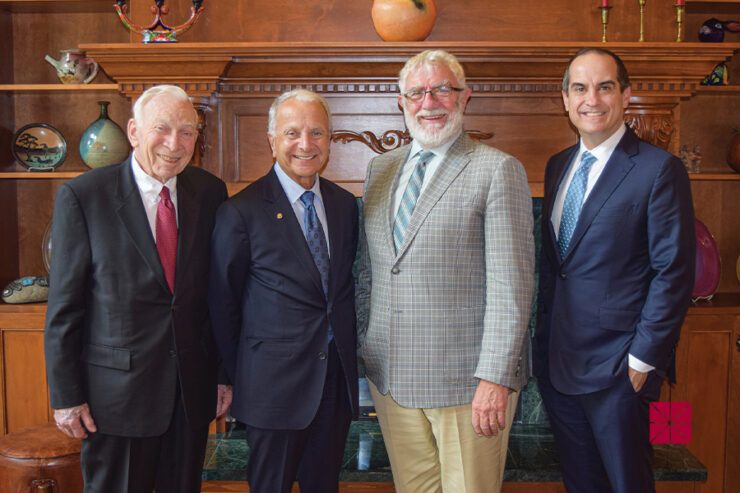
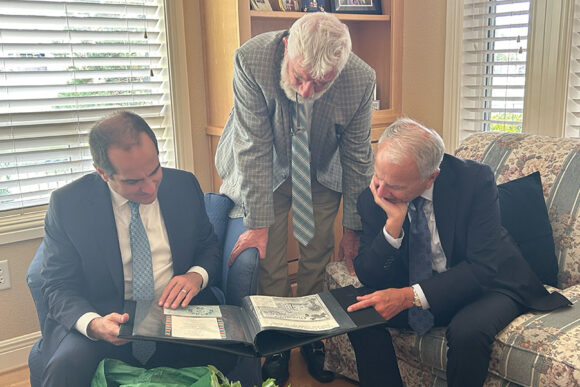
As Parlow was preparing to become president in 2025, he traveled with Doti and Struppa to visit Buck and Joni at their home in Medford, Oregon, because the couple could not attend Parlow’s inauguration. The four living Chapman presidents have nearly 100 years of service to the university between them, and each can rattle off specific dates, names, and anecdotes from decades ago as if they all happened yesterday.
“What was wonderful about the time we spent together was sharing stories of where we were, where we are, and where we’re headed. There was a deep love and appreciation not just for Chapman, but for the Chapman Family and what we have all done together,” Parlow said.
Joni passed away in June 2026, one year after hosting the presidents in her living room and leaving the newest president with a one-of-a-kind gift.
“Before we left, Joni gave me a handcrafted scrapbook with photos and memorabilia from their time at Chapman — keepsakes they had held onto for 40 years. The scrapbook sits on the coffee table in the President’s Office,” Parlow said. “This is what the Chapman Family is all about: making lasting connections that have a ripple effect for generations.”