 Nicole Bigley
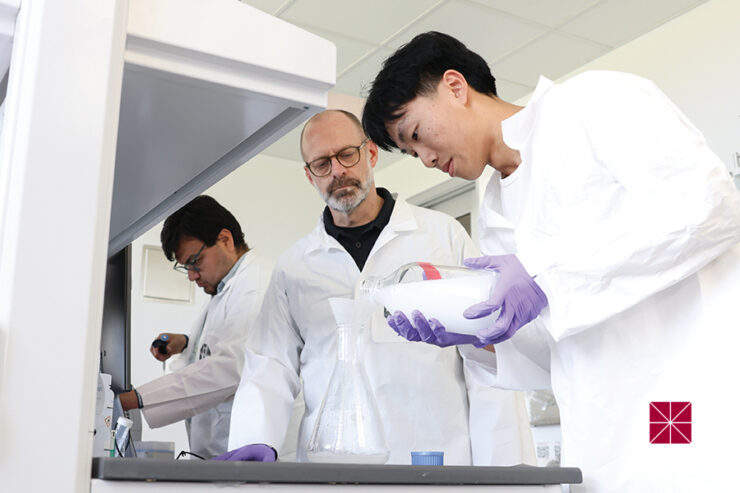
When students in a biomaterials lab led by L. Andrew Lyon, Ph.D., began experimenting with a new material designed to mimic living tissue, there was little existing research showing them how to do it. No published method existed for several of the questions they were trying to answer.
Lyon, a professor of chemistry, encouraged the undergraduate researchers to develop the methods themselves — testing ideas, revising protocols, and learning through failed experiments as the project evolved.
The work eventually became the foundation of a study published in Advanced Materials describing a new biomaterial that behaves more like living tissue than traditional synthetic materials. Researchers say the material could eventually help scientists create better approaches for wound healing and repairing damaged tissue. Much of the experimental work behind the study was carried out by Chapman undergraduates, several of whom shaped the direction of the project over years.
“The conversations I was having with them were deep intellectual conversations where they were collaborators and intellectual partners in the work,” said Lyon, who has a joint appointment between the Schmid College of Science and Technology and the Dale E. and Sarah Ann Fowler School of Engineering. “That level of ownership is unusual for undergraduate students.”
The path forward was rarely straight. Experiments failed. Methods changed. Some questions led nowhere. Over several years, students graduated and new researchers joined the lab, each inheriting part of the project and pushing it forward.
Every tissue in the body relies on a microscopic support structure that helps cells grow, move, and repair damage. Re-creating that environment artificially has been one of the biggest challenges in tissue engineering.
The material developed in the Lyon lab, a microgel composite, combines collagen — the body’s most abundant structural protein — with ultrasoft nanoparticles that act like molecular Velcro, helping hold the structure together while still allowing cells to move through it.
THE STUDENTS WHO BUILT IT
Sanika Pandit ’22 joined the project while researchers were still trying to understand what the material could actually do. Later, Elif Narbay ’23 helped develop the first protocols for forming collagen gels and integrating microgels into the system. “I had to build the methodology from the ground up,” Narbay said. “A lot of it came from piecing together existing literature, intuition, and iteration.”
“The conversations I was having with them were deep intellectual conversations where they were collaborators and intellectual partners in the work. That level of ownership is unusual for undergraduate students.”
— Andrew Lyon, chemistry professor
By the time Abbygail Caine ’25 entered the lab, the material was beginning to take shape — but some of the project’s most important discoveries were still ahead.
Caine eventually led the key experiment that triggered collagen self-assembly inside the microgel composite, helping researchers better understand how the material reorganized itself at a microscopic level. But the process involved repeated setbacks and failed experiments before the team began seeing consistent results.
During laboratory testing, cells continued growing inside the dense material, behavior researchers normally would not expect in a structure packed this tightly.
“Elif and Abby dug into the literature, convinced themselves the work was brand new, and developed a passion and ownership that fundamentally changed how they approached every experiment,” Lyon said.
Today, Pandit and Caine are both pursuing Ph.D.s at the Lampe Joint Department of Biomedical Engineering at North Carolina State University and the University of North Carolina at Chapel Hill, where they both hold National Science Foundation Graduate Research Fellowships. Narbay remained in Lyon’s lab as a research associate mentoring undergraduate researchers and developing the project’s next phase, before beginning her Ph.D. in biomedical engineering at University of California, Santa Barbara this fall.
Student co-authors include Gabrielle Montgomery ’25, Marion Harper ’27, Hatte Hamilton ’26, Megan Hicks ’26, and Kyle Choy ’24, along with Grand Challenges Initiative Fellow E. Daniel Cárdenas-Vásquez and Marco Bisoffi, Ph.D., an associate professor of biological sciences, chemistry, health sciences, and pharmacy.
None of the students arrived knowing where the work would lead. Over time, they learned to ask the right questions, build methods from scratch, and revise experiments through failure.
“A lot of progress came from things not working,” Caine said. “Instead of giving up, I just tried to collect in my mind what did and did not work, and pivoted.”