Chapman Newsroom
Main Menu >
A Deeply Personal Endeavor: Matt Parlow Carries the Chapman Legacy Forward
For President Matt Parlow, leading Chapman into its next chapter is a lot like coaching a team through a championship season: it requires vision, discipline, and the belief that greatness is achieved together.
By Abigail Ramsey
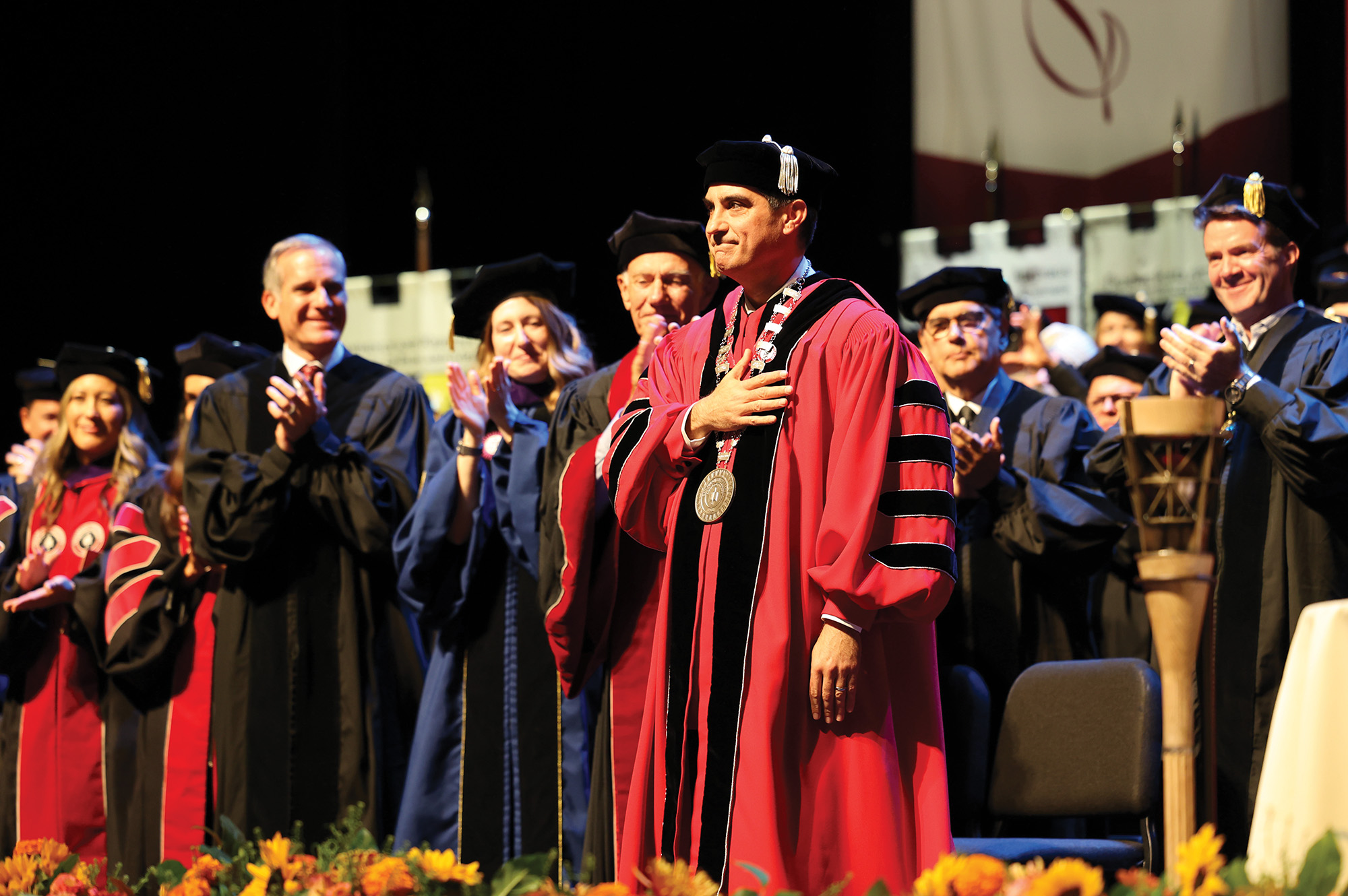

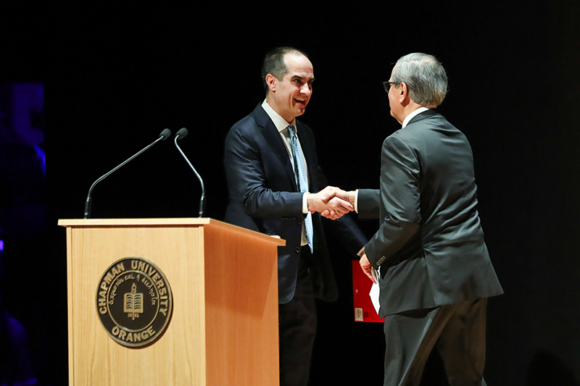
For more than three decades, Chapman University has experienced exponential growth thanks to the expert leadership of Presidents Emeriti Jim Doti and Daniele Struppa. First, Doti transformed a regional college into a comprehensive university and built the scaffolding for Struppa to take it even further. Under Struppa, Chapman excelled in academic rigor, establishing the institution as an R2 university and a hub for some of the highest research activity in the country. As Chapman’s 14th president, Matt Parlow has a profound understanding of the presidential tradition of excellence that he now helms. For him, every step forward in Chapman’s story is deeply personal.
Mementos decorate Matt Parlow’s office—photos of his wife, Janine, two daughters, Maya and Hannah, and their dog Maisy; a memory of meeting his grandfather; portraits of mentors and heroes; and a framed sport jersey gifted to him by his first class of law students at Chapman—each representing experiences that have shaped his life and career. And all of them are important for the next step.
Parlow enters his role as president while higher education is at a critical point. Students and their families are asking whether degrees are worth the investment, and Parlow believes Chapman has a responsibility to answer these questions head on. To do that he is leaning on a passion for education, people, and Chapman’s mission to deliver personalized and powerful educational opportunities.
Humble Roots
In his story and in his parents, Parlow saw firsthand education’s transformational power.
Growing up in Hollywood, he remembers much of his childhood was spent bussing between schools. From Ivanhoe Elementary School in Silver Lake to Walter Reed Junior High School in Studio City, and from the humanities magnet program at Cleveland Charter High School in Reseda to Loyola High School near Downtown Los Angeles, each of these experiences were testaments to how Parlow’s parents prioritized education against all odds. For them, it was a way to provide opportunities that they didn’t have.
“They scraped and scrapped and clawed their way to a college degree, hoping to give me and my brother a stable upbringing,” Parlow said. “That really struck me even as a kid. I understood what they were doing.”
Parlow’s father, Richard, grew up in an orphanage in Brooklyn. His mother, Anita, was raised in a foster home in Upstate New York. Both of them sought stability and opportunity in their adulthood, moving west to attain it. They worked to pay their way through night classes at community colleges and landed teaching jobs at Hobart Elementary School, where the two of them met.
My parents instilled in me a reverence, a love, of education. They taught me the importance of education for social mobility.
President Matt Parlow
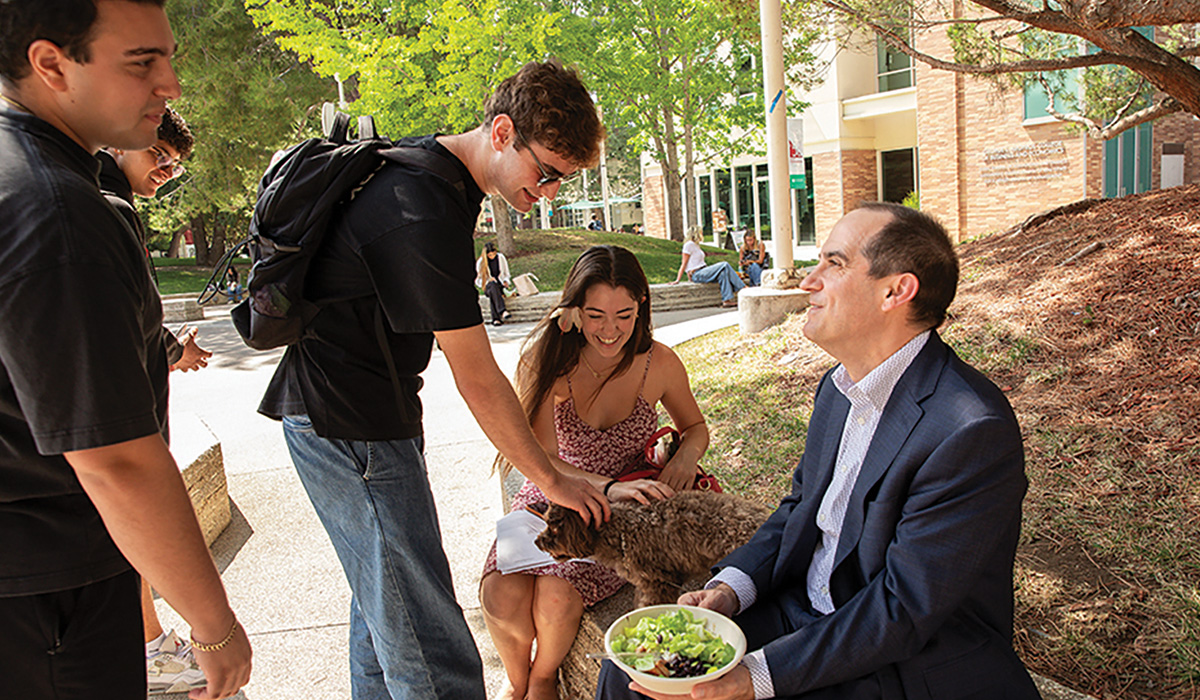
Students are invited to meet President Matt Parlow’s dog Maisy during “Maisy Mondays.”
In each of their classrooms, they identified with the challenges that stood in the way of their students’ education and future, particularly for the low-income students and English language learners from first-generation immigrant households. When the couple eventually married and had Parlow and his brother, they knew they would do anything they could to prioritize educational opportunities for their children.
“My parents instilled in me a reverence, a love, of education,” said Parlow. “They taught me the importance of education for social mobility.”
It was something that Parlow never took for granted. He saw how hard his parents worked—including running an antiquing business on the weekends—to get him into the best schools and extracurricular activities even on humble teacher salaries. When he decided he wanted to go to the all-boys private Jesuit Catholic Loyola High School, Parlow started working in the evenings and weekends to help with the cost of his school. When it came time to think about college, the cost of tuition weighed heavily on his plans.
“I had a full scholarship to college,” Parlow said. “It was the only way I could have gone, to be honest.”
Education was the key that opened doors to opportunities that built a strong career path. Woven into each decision and leap of faith was a passion for connecting with and advocating for people.
Marilyn Harran, Chapman professor and Founding Director of the Barry and Phyllis Rodgers Center for Holocaust Education, saw that passion when Parlow, in his role as Chapman’s executive vice president and chief advancement officer, secured donor funding for the student food pantry and student assistance program.
“Anyone who is the child of first-generation college students, along with first-generation university college graduates themselves, has a very special, deep commitment to what education can mean for your life,” shared Harran.
“I think that’s something that’s just very central to him and his personality. His drive is that sense of privilege to be educated, and he operates today to make that easier and more possible for many other students.”
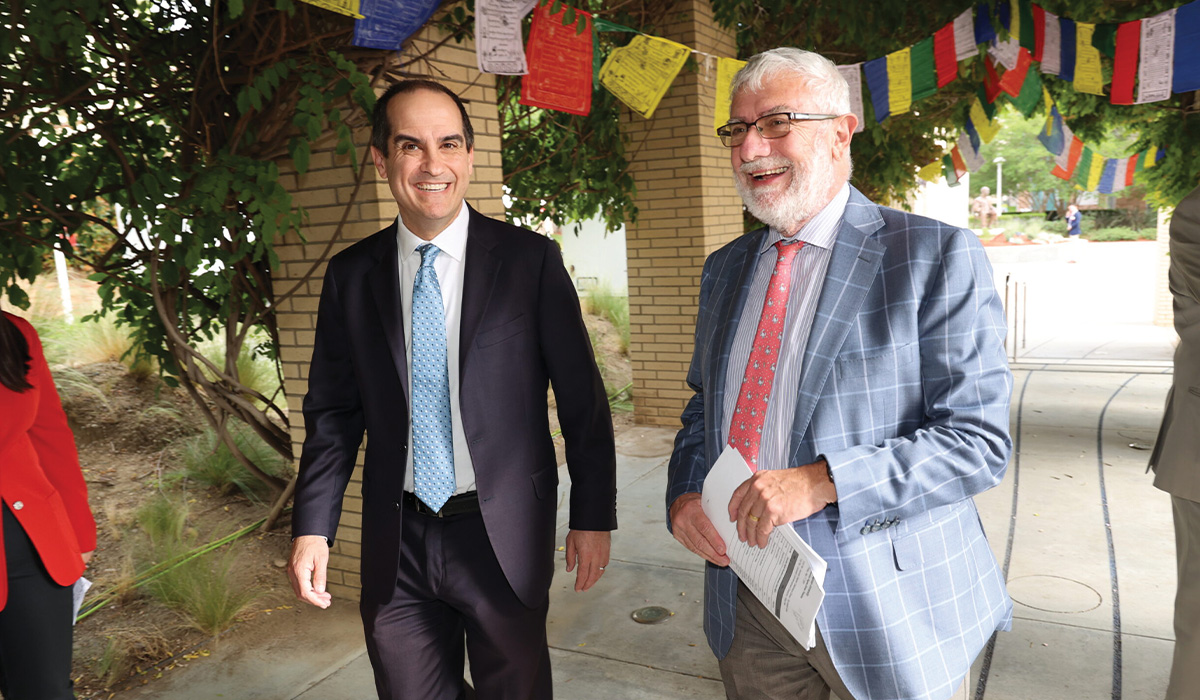
Matt Parlow (left) and Daniele Struppa at Chapman University.
A People-Centric Leader in the Making
Parlow put his passion and talent for connecting with people and advocating for their needs into practice in his undergraduate career at Loyola Marymount University (LMU).
In the swath of student clubs and organizations on the campus, he saw that the LGBT club, known as the Alliance of Gay and Lesbian Students at the time, had not received official recognition as an organization. Noting the inequities, Parlow went to work to address the problem.
“It bothered me,” Parlow stated, “so I led a student government reform.”
Even as a young student, Parlow had a solution-focused mindset that could motivate change.
He became active as a senator in student government, petitioning the university’s administration to change how student clubs and organizations were recognized. They eventually succeeded, their reform making headlines and setting a new precedent for inclusion.
One faculty member, Father Michael Engh, met Parlow as he studied history with the hopes of following his parents’ footsteps and becoming a history teacher. But even in their studies of educational philosophy, Father Engh took note of Parlow’s people-centric attitude.
One of Professor Parlow’s strongest qualities is his patience. The fact that he is willing to take time out of his day to listen to me, and actually listen to me not just nod along, definitely speaks to his qualities.
Brianna Jackman (JD ’27),
intellectual property and
entertainment law student
“He obviously had great potential, was very bright, and very interested in the wider world,” shared Father Engh. “He has a deep respect for the qualities of each person as a manifestation of God’s creativity. He has an openness, then, to people from different backgrounds.”
Parlow never faltered in his involvement and advocacy. He eventually was elected student body president and became the national chairperson of J.U.S.T.I.C.E., a coalition of student governments of Jesuit colleges and universities across the nation, where he continued to build coalitions and connections to address student problems.
“I realized it was the power of law that allowed us to fight for what I saw as a more equitable system,” Parlow said. “That made me want to go to law school.”
So in true Parlow fashion, he set the goal and put it to action. In a gap year post-LMU graduation, Parlow worked for Los Angeles Mayor Richard J. Riordan, developing a love for policy in the process, and studied for the law school admission test.
When the acceptances to law schools came through his top choice was Stanford Law School. His reach school? Yale Law School, one of the five Ivy Leagues with competitive law programs.
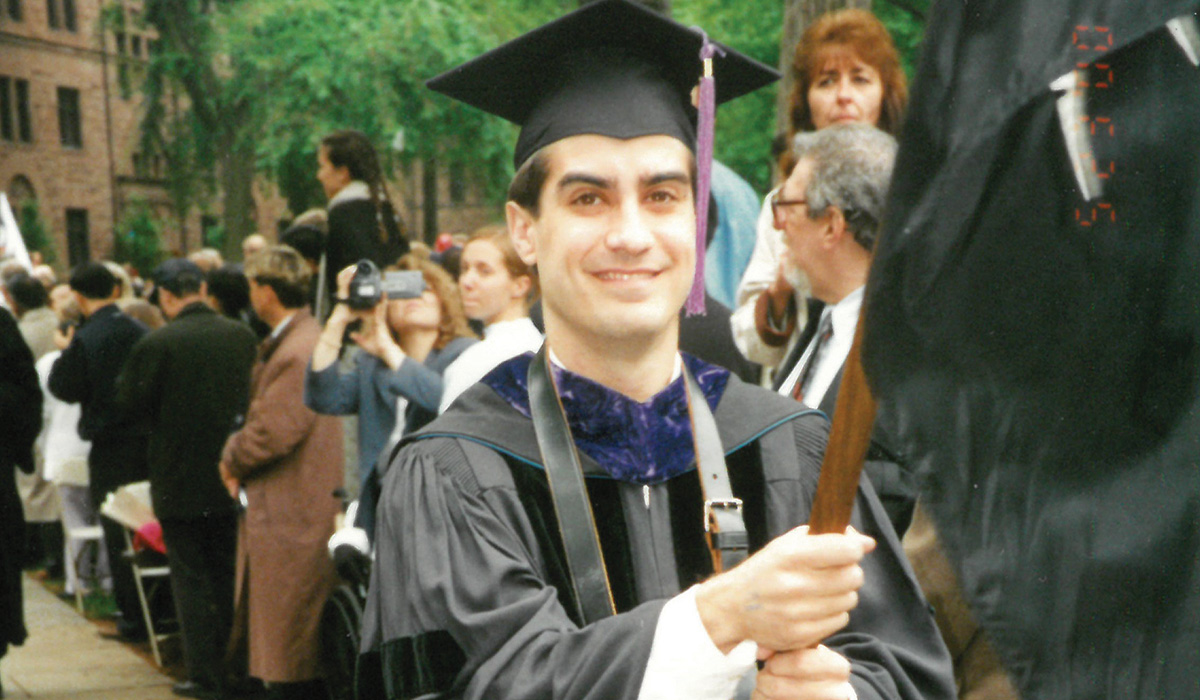
Matt Parlow was chosen as the banner bearer for his graduating class at Yale Law School, where he directed Community Legal Services and contributed to the Yale Journal of Law and the Humanities.
“I remember when I got the packet from Yale, saying to my parents, ‘Oh, this must be just to fill it out for financial aid, there’s no way I’m getting in,’” Parlow laughed. “And I got in. I couldn’t believe it.”
Parlow pushed himself even further, moving far away from the city he loved. But even across the country, his passion for supporting people remained. He volunteered in the community legal services clinics at soup kitchens within New Haven. It was once again a space where Parlow simply wanted to connect with people.
“We would try to help them, whether it was a wrongful eviction, or to try to get Social Security benefits. It really ran the gamut,” Parlow remembered. “I very much felt like it was important to give back to that community.”
But one of the more formative experiences was in his first teaching experience at Yale. Teaching undergraduate political sciences classes deepened his appreciation for the work done within the classroom.
“I loved being a professor because I could help make an impact in the lives of students who were looking to launch their futures and their careers,” Parlow said.
My time at Chapman would not have been the same without Dean Parlow.
Lawyer Clint Jones (JD ’22)
From Mentee to Mentor
Upon graduating from law school, Parlow returned to Los Angeles. Of course, when he sat taking the bar exam, his love for connecting with people led to his first connection to Chapman University.
He struck up a conversation during the California bar exam with M. Katherine Baird Darmer, a distinguished lawyer from New York and a staunch advocate against gender and sexuality discrimination. She had relocated to begin teaching law at Chapman, and Parlow shared with her his hopes of returning to the classroom as a professor.
While he worked at the prestigious Manatt, Phelps, & Phillips law firm practicing property law, Darmer continued to help Parlow find ways to bring his passion for education back into his career. Still, it felt like too many obstacles stood in his path. No one expected such a leap of faith for the young property lawyer.
In 2003, Parlow encountered another obstacle while clerking for the Honorable Pamela Ann Rymer of the 9th Circuit Court of Appeals. He was diagnosed with cancer at 28 years old. In the midst of it, Judge Rymer became a mentor for Parlow. She balanced her tenacious work ethic with immense kindness and hope, seeing him as a multifaceted person not just an employee.
“She was one of the hardest working people, one of the smartest people, but also one of the nicest people I ever met,” Parlow said. “She couldn’t have been kinder and more supportive of me when I was going through my cancer treatment. I learned so much from her integrity about care and her passion.”
Parlow beat his cancer battle with a renewed perspective of what he wanted to do and who he wanted to spend his time with. He listened to his mentors, picking up adjunct and visiting professorships at his alma mater LMU and Whittier Law School, where he met his wife Janine.
When Darmer called him to let him know that a property law professor was leaving Chapman, he knew he would be putting his name in for consideration. In 2005, Parlow began his Chapman story as a faculty member teaching property, land use, and sports law at the Dale E. Fowler School of Law with a commitment to pass down the same mentorship he received to each student he worked with.
For three years, he fell in love with the Chapman community and built strong connections with students, faculty, and administrators to support the bar preparation program and the new entertainment law certificate program. When he moved to Milwaukee to teach at Marquette University Law School, the same passion followed.
Rebecca Lopez, a practicing attorney at Godfrey & Kahn and former student of Parlow’s at Marquette, remembers first meeting him in a property class in her second semester. His energy for the subject was palpable as he led engaging lectures and invested deeply in the individual journeys of his students.
“If it weren’t for him,” Lopez said, “I can tell you affirmatively that I would not have reached the career that I had or even been able to navigate law school. I think part of his philosophy is removing the obstacles similar to those he faced so that others can reach their full potential without it having to be as much of a struggle.”
Administrative Success
Even when Parlow quickly advanced to tenure and associate dean roles at Marquette, he made a commitment to teach as much as he could. Those classrooms gave him a strong understanding of student needs so he could address barriers in each of his administrative roles.
“He could see a challenge that the law school or the university faced, and he wanted to be a part of the solution,” remembered Mike Gousha, senior advisor in law and public policy at Marquette. “He was able to look at things strategically and then execute a plan.”
Some of Parlow’s most notable successes at Marquette included growing curricular offerings with two new certificate programs and new joint degrees, engaging law students in the community with partnerships and events, and launching a speaker series to welcome legal experts to the campus.
I really admire how much he makes every individual person feel valued. Whenever someone comes into his office, he always has a smile and will stop what he’s doing to talk to them.
Adam New ’27,
creative producing student
“Matt just has boundless enthusiasm and reserves of energy for accomplishing things that most of us can scarcely dream of,” said his former colleague and dean of Marquette University Law School Joseph Kearney.
When Parlow returned to Chapman in 2016 as the dean and Donald P. Kennedy Chair in Law at Fowler Law, he stepped forward with the same momentum. Doti, who had taken note of Parlow when he first joined Chapman as a faculty member, recalled how Parlow’s quick command of the law school further exemplified exceptional leadership qualities.
“I knew he was a great academic, great researcher,” Doti said. “But he came back with the confidence he had gained as the associate dean. And he hit the ground running.”
As dean, he raised the standards for admission at Fowler Law, increased alumni donors by 500% and eliminated a deep budget deficit. Such growth attracted some of the brightest incoming students and exceptional faculty that together helped the law school climb more than 20 spots in national rankings.
Lan Cao, the Betty Hutton Williams Professor of International Economic Law at Fowler Law, remembers the power of Parlow’s leadership. Parlow’s experience as a faculty member helped him pinpoint where faculty needed support and resources and where they needed to be left alone to their research.
“He ran the law school in a holistic way,” Cao said. “He was very supportive of what we wanted to do, so we could give our full service and full teaching capability to the law school.”
Struppa, inspired by Parlow’s fundraising at the law school, asked Parlow if he’d be interested in working with him to scale his impact on Chapman even greater. It was a leap of faith to go from law school dean to executive vice president, but Parlow took the risk and excelled once again.
“I’ve known him for 25 years,” said Andres Irlando, CEO of Vocus Group and Chapman Trustee. “I’ve seen him work in government, politics, law, higher education, business—and everywhere he goes, he’s successful.”
Parlow launched one of the most ambitious fundraising campaigns in Chapman’s history, known as Inspire: The Campaign for Chapman University, which has raised over $431 million to date. As an ambassador of Chapman’s mission, Parlow secured historic gifts to support endowments, student scholarships and more.
Struppa could rely on Parlow’s partnership to bring in the resources needed for exceptional faculty research and student academic excellence that Chapman is now known for.
“Daniele leads with his values, with his heart,” said Parlow. “I’ve grown tremendously under his mentorship and working side by side with him.”
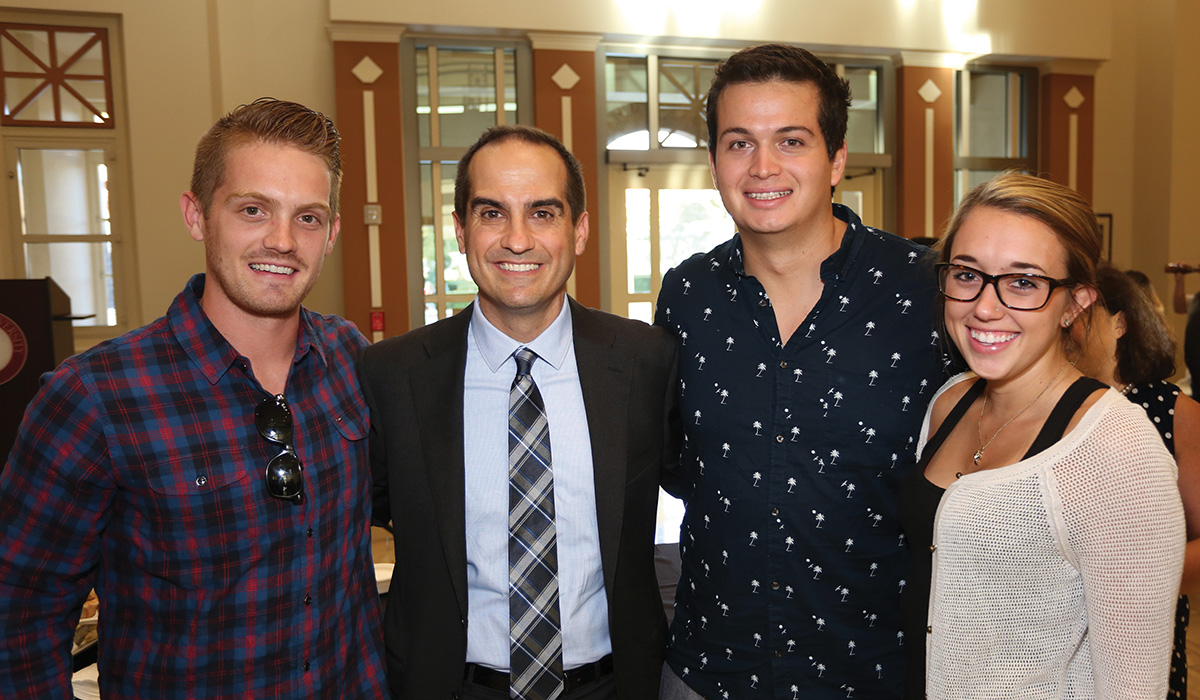
President Matt Parlow is dedicated to supporting Chapman students with their academic goals.
Carrying the Chapman Legacy Forward
Now, Parlow gets to follow in Struppa’s visionary leadership. If Doti is the builder and Struppa the scholar, Parlow considers himself the connector. His predecessors at Chapman handed him a sturdy foundation, and now he gets to use his bridge-building talent to reach the next chapter.
“Matt is a person of great integrity,” Struppa said. “The university needs somebody who has that quality. He is a brave and very solid person. He’s very smart, very intelligent. He understands complex situations, and he’s able to analyze complex situations from different perspectives. But maybe the most important thing is he loves Chapman. Matt has a passion for this institution.”
Students in today’s world must develop a range of interdisciplinary skillsets to launch their careers. Parlow believes Chapman is the place they can get such a transformational education.
Parlow intends to lean into the traditions—data-driven goal setting and a fine-tuned focus—set in place by Doti and Struppa. To build on the academic rigor at Chapman and better, he is committed to building lasting relationships with key stakeholders in the Orange County and global communities.
“Chapman is not just a university,” said Annette Walker, Chapman Trustee and President of City of Hope Orange County. “It’s a university inside a very special community. Matt has a good grasp and understanding of the Orange County community and its supporters and how this ecosystem functions.”
He hopes to strengthen Chapman’s reputation as a convener of some of the most esteemed and wide-ranging voices to explore thoughtful solutions to the issues facing our world. A powerful side effect of such important conversations is students becoming inspired to be active contributors to the world around them.
“To me, this is also deeply personal,” Parlow said with reverence and excitement for his role as president. “I love Chapman. It’s been a home for me in so many ways. It’s a community I feel really connected to. And it has so many people I care so much about.”
Jim Burra, Chair of the Chapman Board of Trustees, believes Parlow’s love of people sets him up to be a successful president. “I see him when he talks to people. He talks to them with respect. He listens to what they have to say, and he lets them know that he understood.”
Carrying Parlow through these commitments is his energy. Almost everyone who has the pleasure of working with him can see it.
“When I think of Matt, I see this energizer,” Walker said. “He has a tremendous amount of energy that’s very focused. I’m very excited to see how he takes that. Chapman gets the best of it.”
The source of such zeal? Arguably, his love for sports.
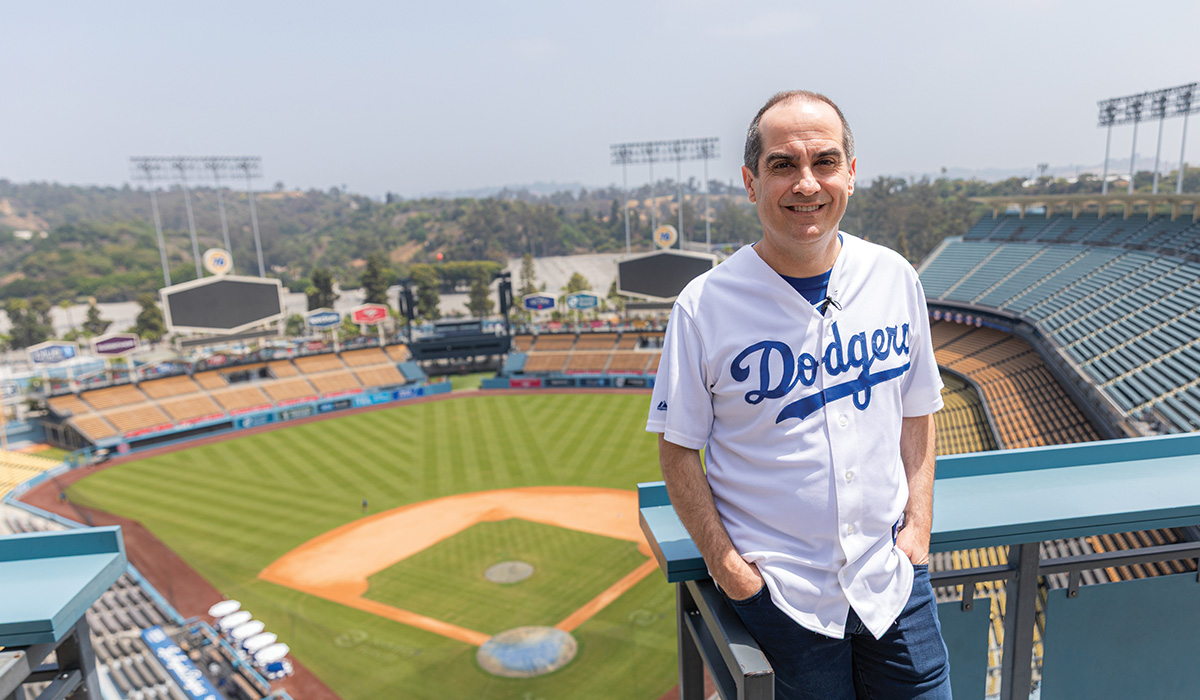
President Matt Parlow is a longtime baseball fan and loves the Los Angeles Dodgers.
One of his earliest memories was sitting on the floor of his parents’ bedroom watching the final seconds of the 1981 World Series as the Los Angeles Dodgers won the championship.
Parlow’s parents saved up for tickets to a few Dodgers games every year, encouraging his fascination with the Dodgers and Los Angeles Lakers to take root.
“I love the competitive aspect of sports,” Parlow says, “and I really value teamwork that elevates individual talent to come out on top. I also particularly admire those players who are super physically gifted, but their drive makes them one of the greatest players of all time.”
Players like the late Lakers guard Kobe Bryant and Dodgers favorites Jackie Robinson, Steve Garvey, and Clayton Kershaw are some of those players in Parlow’s mind. Each is dedicated to their sport, improving in any skill they can while recognizing their success in championships requires both physical talent and a strong connection to the team surrounding them.
While at Marquette Law School, Parlow teamed up with Major League Baseball Commissioner Emeritus Bud Selig. Together they taught sports law to aspiring lawyers, but Parlow remembers learning a lot about leadership from Selig in that role.
As Selig shared the importance of collective bargaining for fair player contracts, he also shared how he managed to get buy-in from such different club owners, each with competing interests and motivations. He had a talent for getting people to see the bigger picture and work through challenges.
“You can apply these lessons to anything in life,” Parlow said. “At Chapman, we have incredible students, and our job is to maximize their experience, enhance their opportunities in and out of the classroom, and help them learn together and continually grow to become productive citizens who contribute to our world.”
For Parlow, leading Chapman into its next chapter is a lot like coaching a team through a championship season: it requires vision, discipline, and the belief that greatness is achieved together.
“The community, faculty, staff, students, board members, friends of the university really bought into the vision that Jim had and Daniele carried forward,” Parlow said. “And that will continue on in the future.”
Like how Doti left a strong foundation for Struppa to build upon, Struppa is leaving Parlow an exceptional university to continue to uplift and shape with his expertise and talent as a connector.
“My hopes for Chapman’s future are to continue on the exciting trajectory that we’ve been on,” said Parlow. “Let’s go do it.”
My hopes for Chapman’s future are to continue on the exciting trajectory that we’ve been on. Let’s go do it.
President Matt Parlow
Published in the print edition of the Chapman Magazine Winter 2025 Issue, with the headline
“A Deeply Personal Endeavor: Matt Parlow Carries the Chapman Legacy Forward.”
Photography by Adam Hemingway and Tony Lattimore
Design by Ryan Starr and Vivian To
You May Also Like
Media Contacts
Office of Public Relations
PR@chapman.edu
Strategic Marketing and Communications
1 University Drive
Orange, CA 92866
Contact Us
Strategic Marketing and Communications
1 University Drive
Orange, CA 92866
Contact Us
Newsroom Site

Your Header Sidebar area is currently empty. Hurry up and add some widgets.